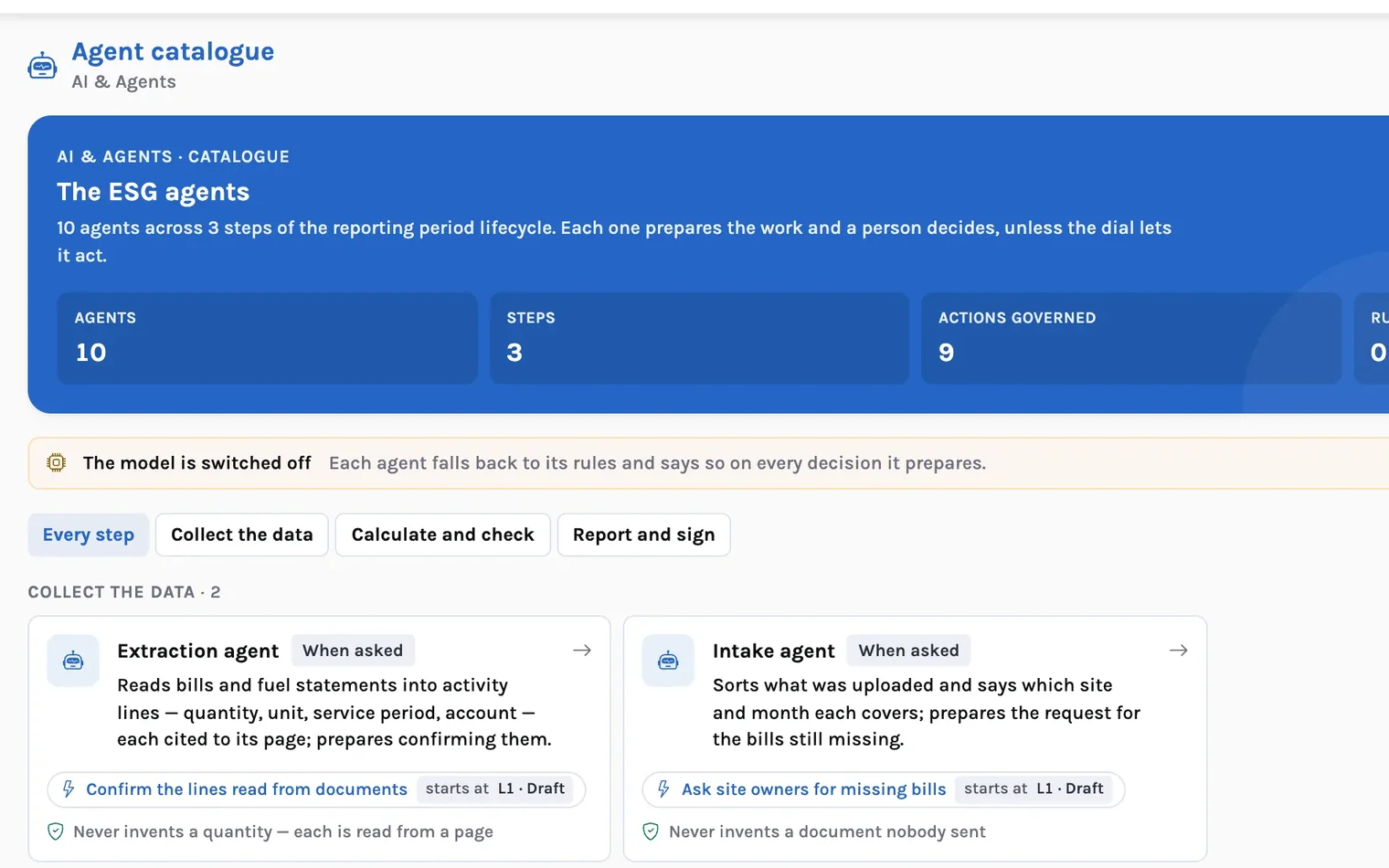
Intake agent
Sorts what was uploaded, says which site and month each covers, and prepares the request to site owners for the bills still missing.
Never invents: a document nobody sent
An agent in ESGBlade reads, checks, drafts and prepares a decision. It doesn't send, sign, change your data or publish on its own: a person answers Accept, Reject or Ask, and the answer goes on the decision record.
The agents are grouped by when they work in a reporting year, as in the product's own catalogue.
Sorts what was uploaded, says which site and month each covers, and prepares the request to site owners for the bills still missing.
Never invents: a document nobody sent
Reads bills and fuel statements into activity lines (quantity, unit, service period, account), each cited to its page, and prepares confirming them.
Never invents: a quantity: each is read from a page
Proposes the emission factor, or the supplier's industry, for lines that can't be calculated, from the published library, with the reason. Learns from what people confirm.
Never invents: a factor: only library entries
Recalculates the period, reads the checks (gaps, bills entered twice, outliers, estimates) and prepares the fixes.
Never invents: a gap or an outlier: the checks find them
Explains what drives each scope and what moved against the prior period, largest first, in words a CFO or a customer can read.
Never invents: a figure or a cause the data doesn't show
Ranks suppliers by their share of spend-based Scope 3 and drafts data requests to the largest. Every message is held until a person sends it.
Never invents: a supplier's figure
Runs the inventory controls and prepares the lead's sign-off when nothing blocks it, or says what stands in the way.
Never invents: a sign-off: the lead signs
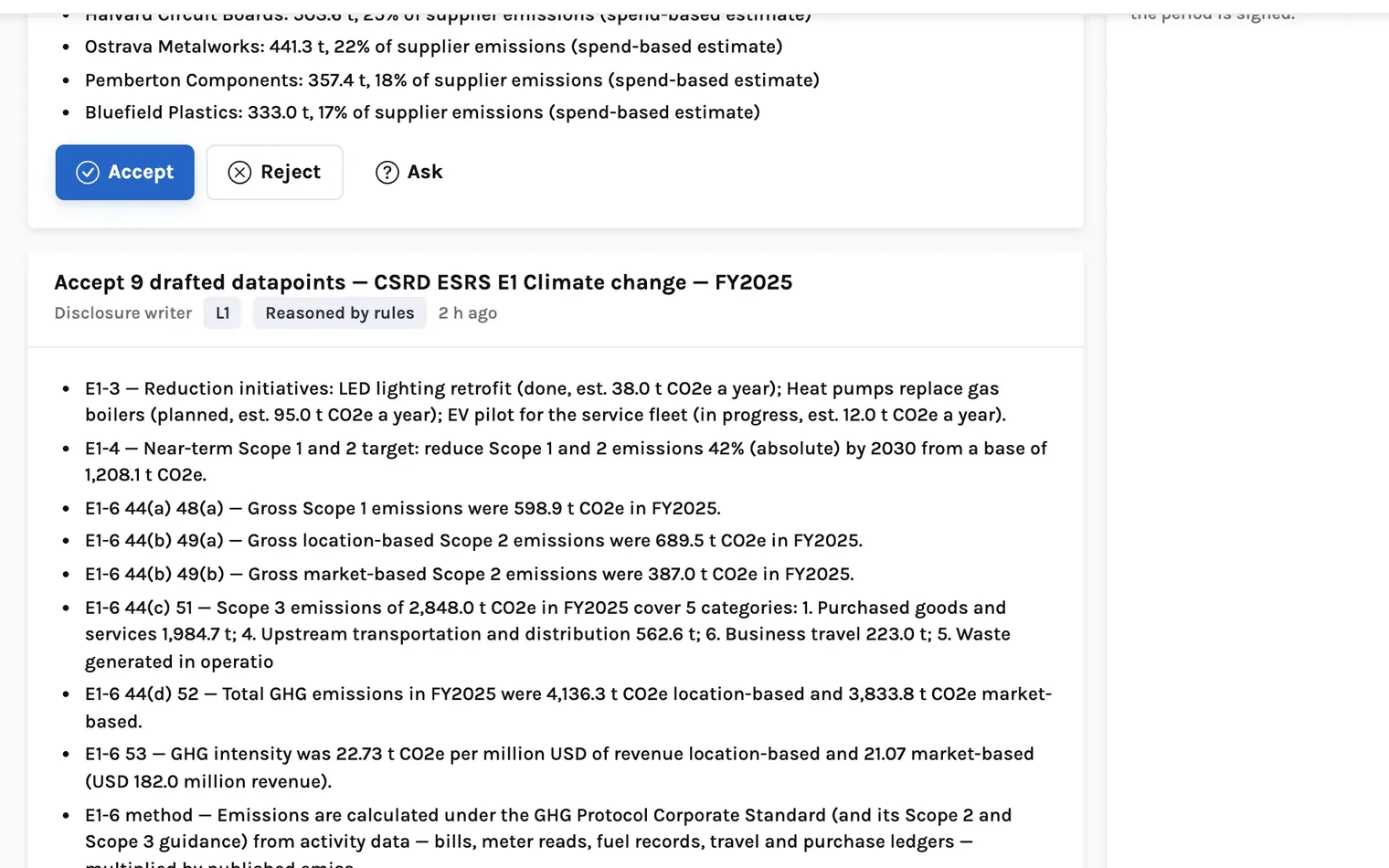
Drafts each datapoint of ESRS E1, ISSB S2, SB 253 and GRI 305 from the inventory and the evidence, and says what a person must supply.
Never invents: a figure, target, policy or commitment
Answers customers' and ratings' questionnaires from the inventory and the evidence, with citations, and marks what it can't answer.
Never invents: a certification, policy or figure
Prepares the double materiality assessment, proposing the climate scores from the inventory for the team to score and approve.
Never invents: a materiality conclusion: the team decides
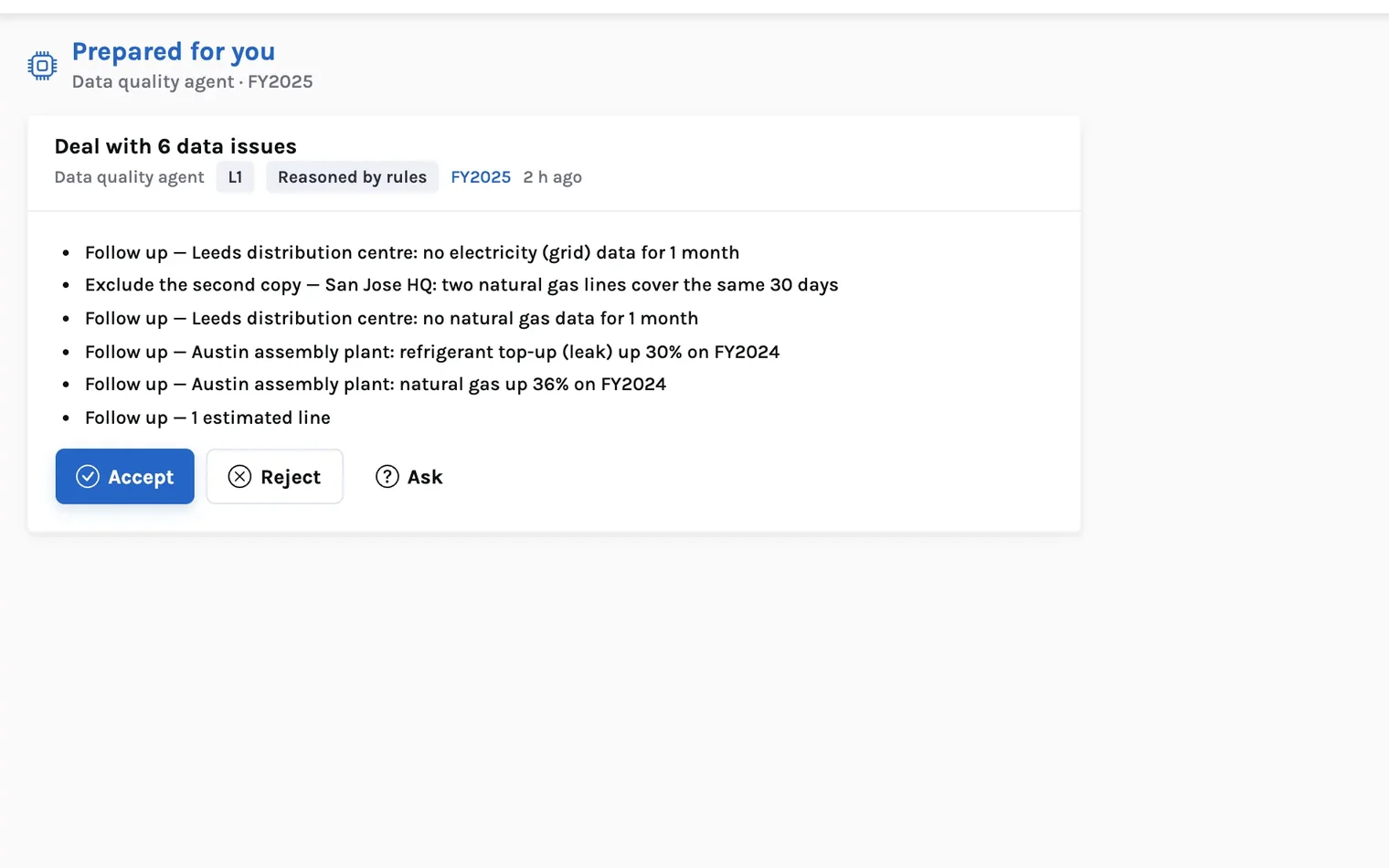
Each prepared decision says what the agent found, what it proposes and what it rests on. "Deal with 6 data issues" lists the second copy of a gas bill to set aside and the follow-ups to log. Accepting carries it out and recalculates; rejecting does nothing and records that you declined; asking records your question against it.
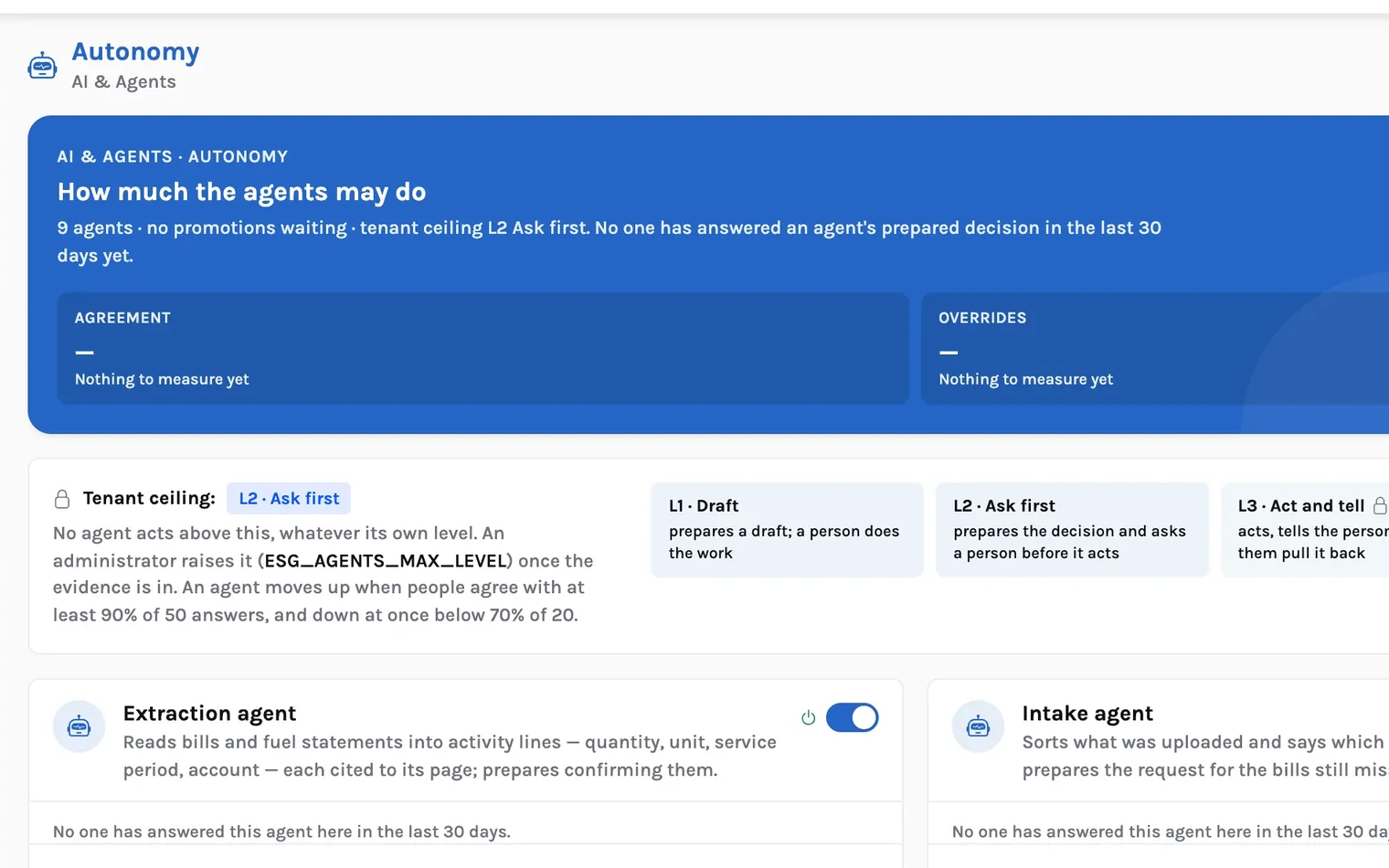
Each agent and action has a level: L1 Draft, L2 Ask first, L3 Act and tell, L4 Act. In ESGBlade the ceiling is L2 for every action, so whatever an agent's level, a person decides. The dial shows how often people agree with each agent, so you can see which ones have earned trust.
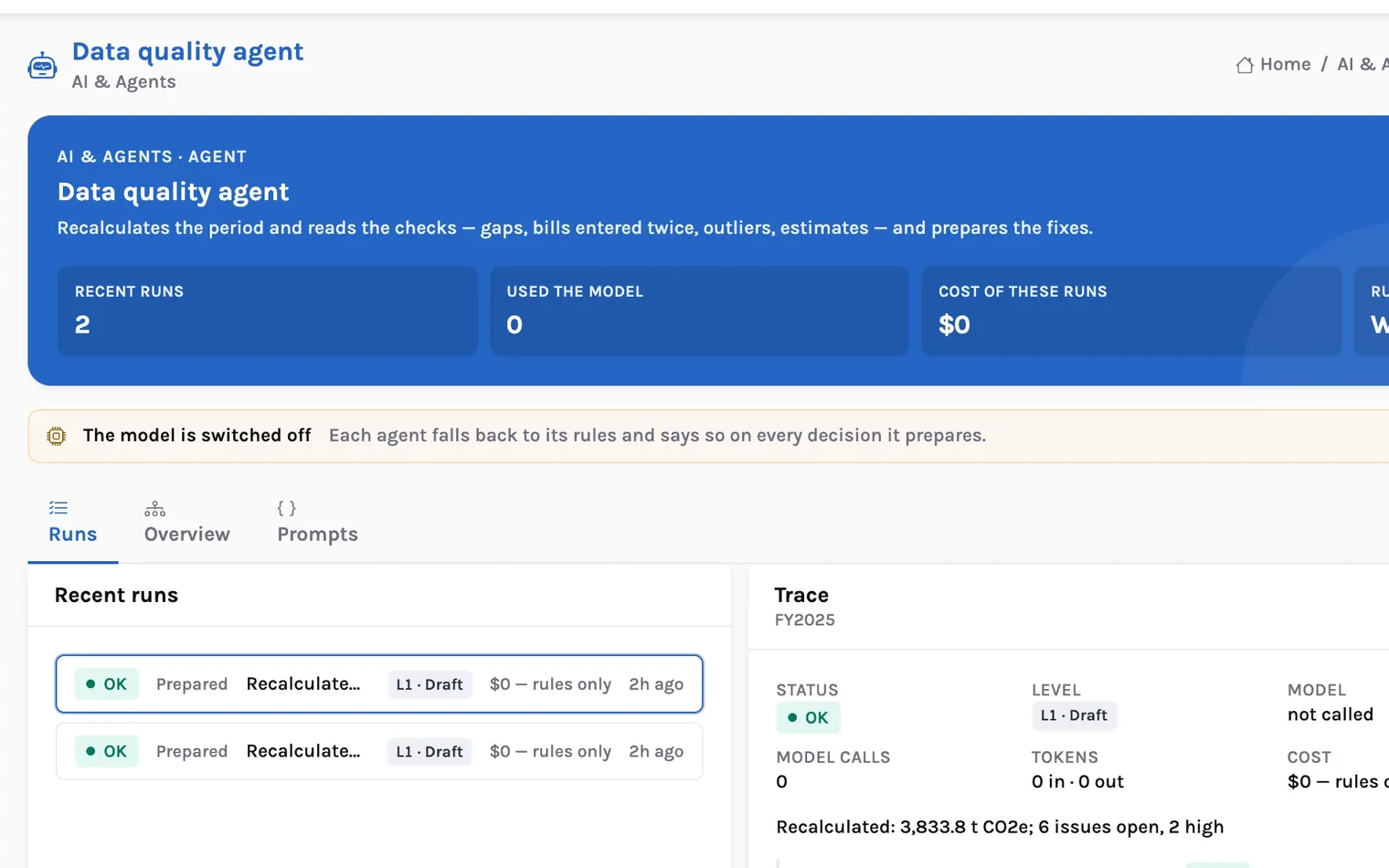
When the model is on, it phrases what the rules found. Every number in its answer is checked against the facts it was given; a sentence with a number that isn't there is thrown away and the agent's own wording is used instead. Anything the data can't answer (a target, a policy, a transition plan) is written as Needs input for a person.
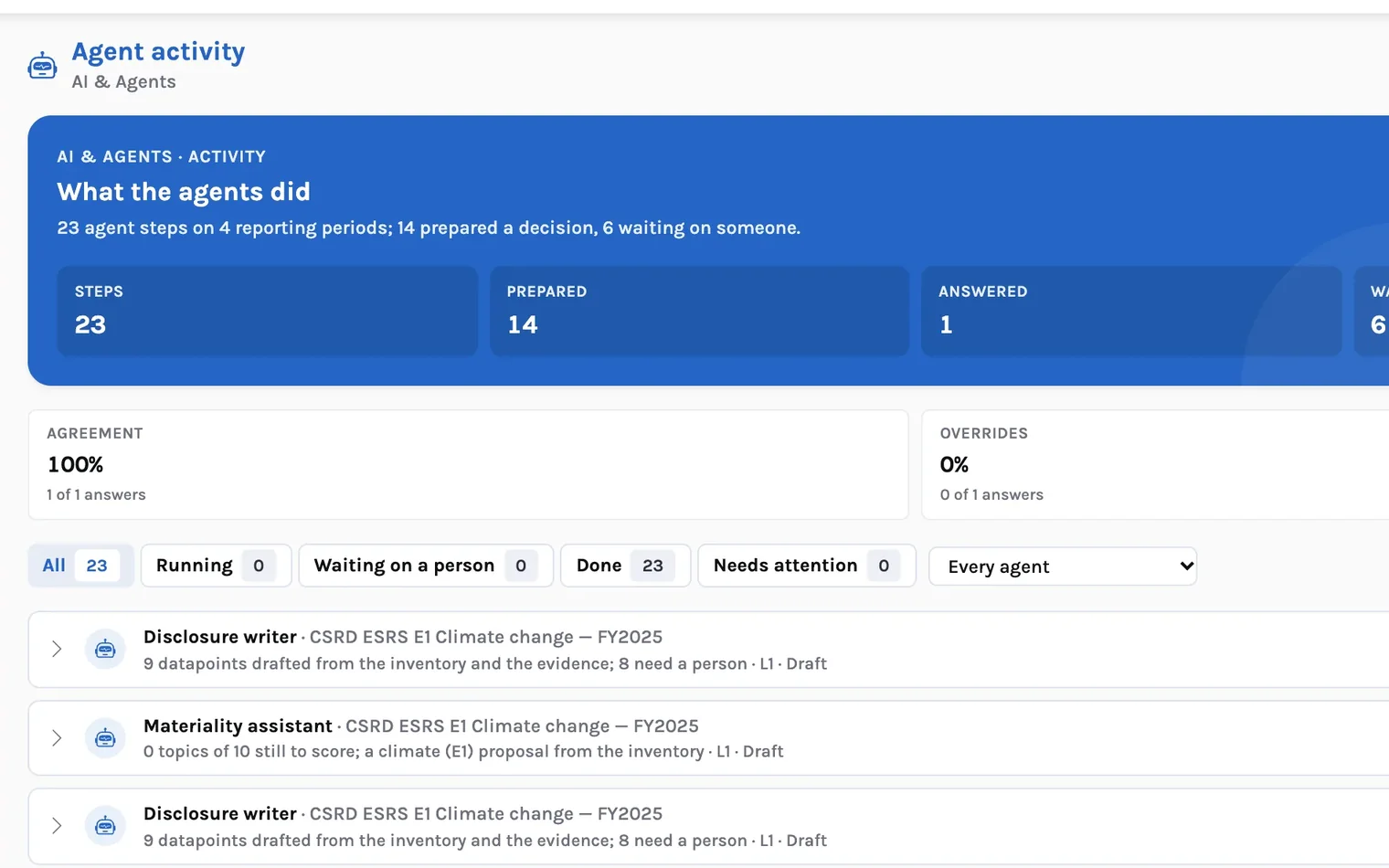
Every agent step on every period and disclosure, with what it prepared and whether someone has answered. The home page shows the same list as "What needs me".
The Agents tab on a period shows the analyst's read, the decisions waiting on you, and each agent's headline from the last run.
The catalogue groups the agents by when they work in a reporting year, and shows each one's actions and the level they start at.
ESGBlade is free. Tell us about your company and we'll set up a workspace for your first reporting period.