Most of the time spent on a greenhouse gas inventory is not judgement. It is sorting uploads, reading bills, chasing the one site that hasn't sent September, noticing that a gas bill went in twice, and drafting the same request to suppliers. That work is a good fit for software. The judgement, whether a figure is right and whether a period can be signed, belongs to a named person in your company.
ESGBlade splits the work along that line. Ten agents do the preparation. Each one stops at a prepared decision, and a person answers it. This post explains how that works, using the fictional demo company Cedarline Instruments and its sustainability lead, Maya Chen.
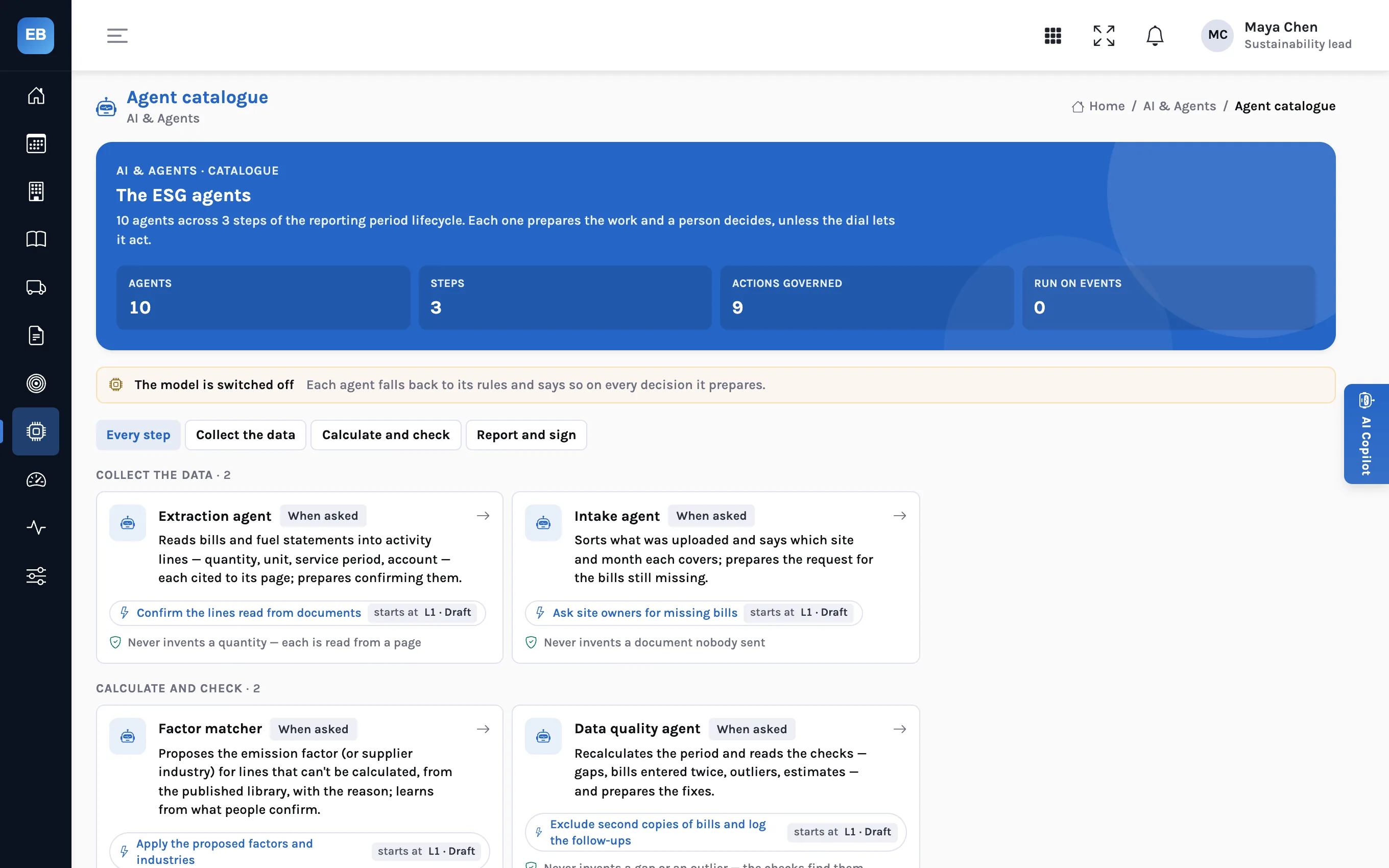
The ten agents
The agents follow the order of the work: collect, calculate and check, report and sign.
| Agent | What it prepares | What it never does |
|---|---|---|
| Intake | Sorts uploads by site and month; drafts the request to site owners for missing bills | Invent a document |
| Extraction | Turns bills and fuel statements into lines cited to the page | Change a quantity |
| Factor matcher | Proposes a factor or NAICS industry for lines that can't be calculated, with the reason | Use a factor outside the library |
| Data quality | Recalculates, reads the checks, prepares fixes and follow-ups | Resolve an issue by itself |
| Inventory analyst | Explains what drives each scope and what moved, largest first | Do the arithmetic; code does that |
| Supplier outreach | Ranks suppliers and drafts data requests | Send a message; each is held |
| Supervisor | Runs the controls; prepares sign-off or says what blocks it | Sign the period |
| Disclosure writer | Drafts ESRS E1, ISSB S2, SB 253 and GRI 305 datapoints | Invent targets, policies or commitments |
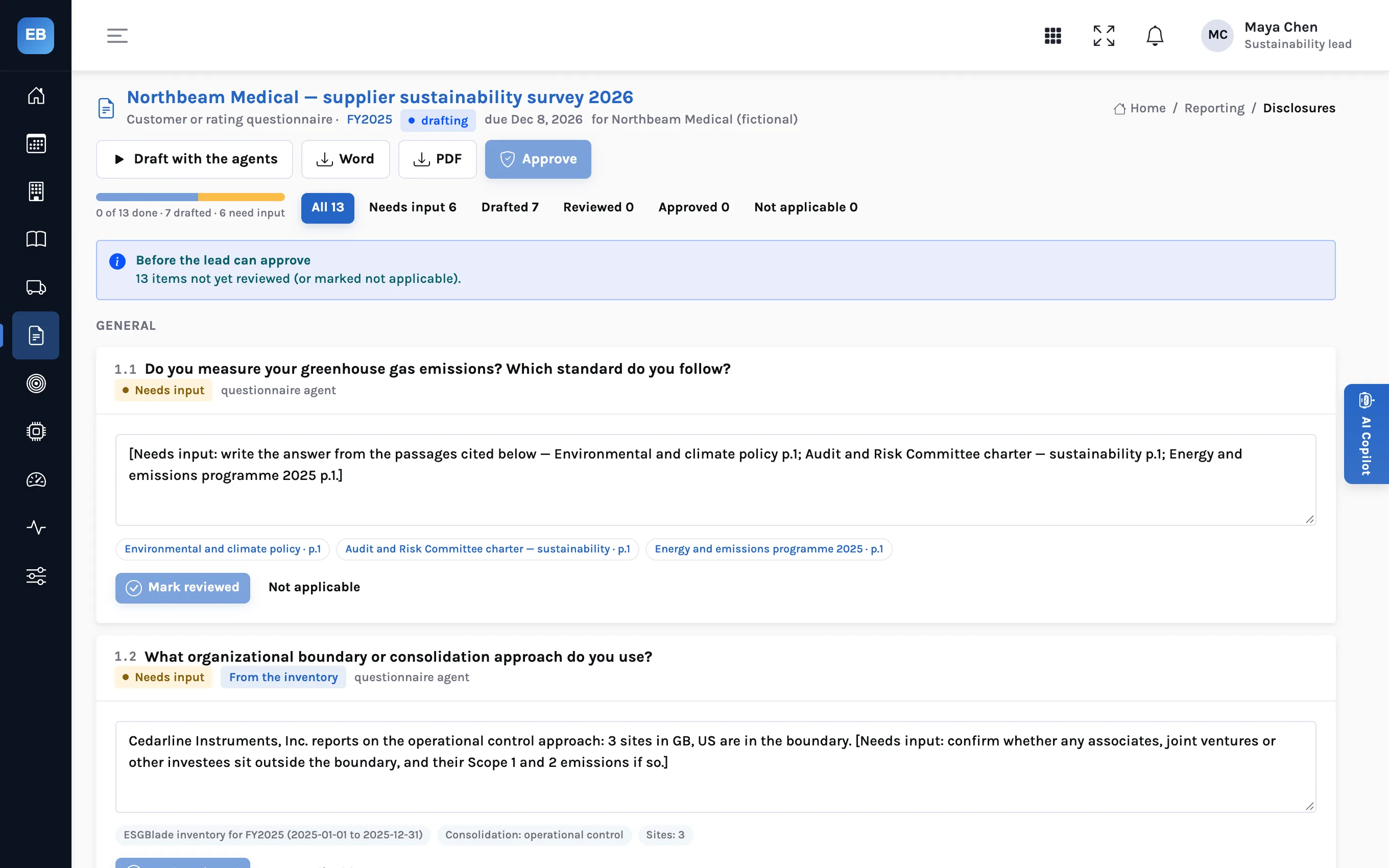
| Questionnaire responder | Answers imported customer questionnaires with citations | Answer what the evidence doesn't support |
| Materiality assistant | Proposes the climate (E1) scores from the inventory | Approve the assessment |
What a prepared decision looks like
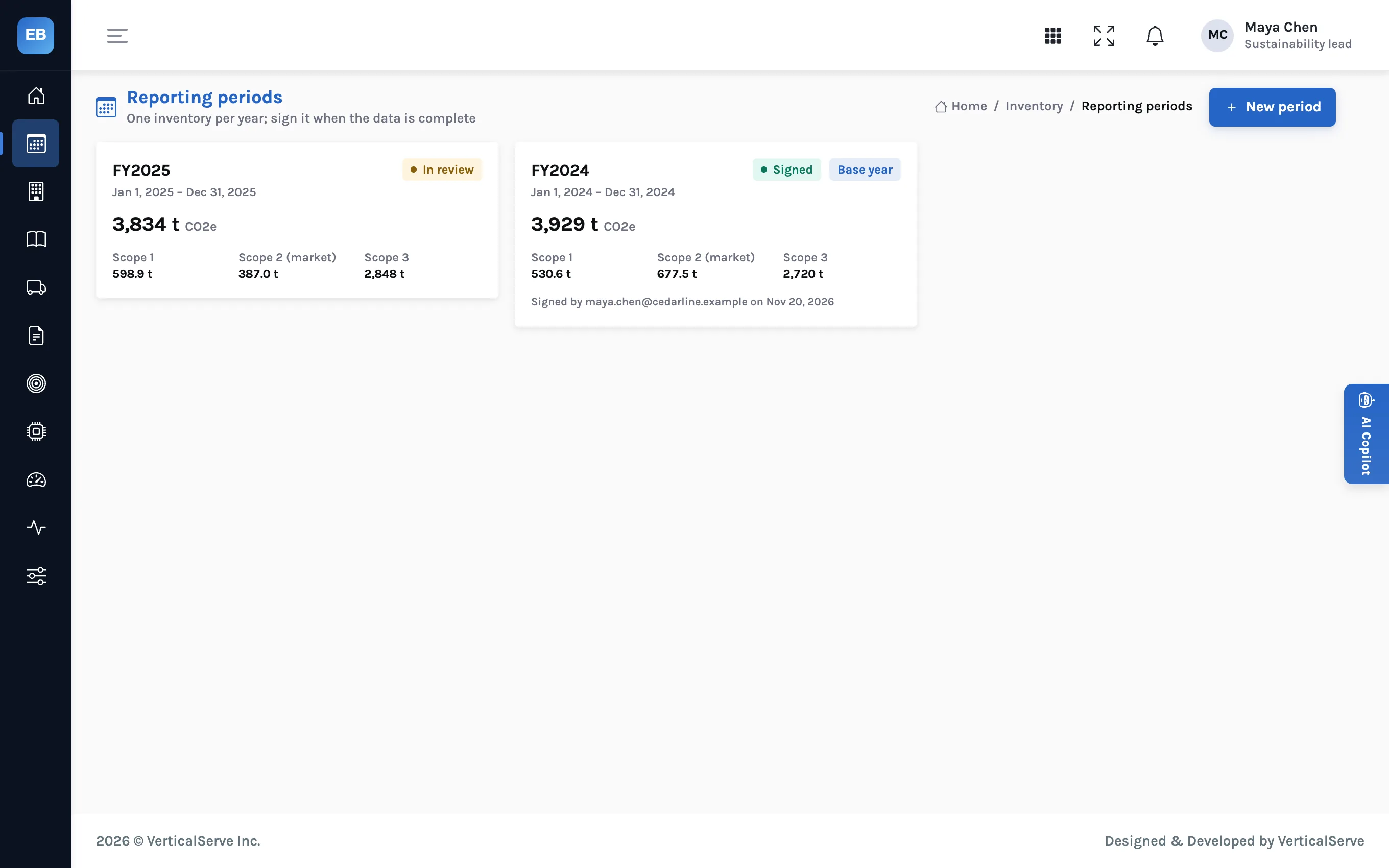
Maya opens the FY2025 period and chooses Run the agents. Each agent does its part in turn. When the run finishes, the Agents tab shows the analyst's read of the period and a short list of prepared decisions. For Cedarline the run prepared these:
- Ask for the bills behind 2 gaps (Leeds electricity and gas for September 2025).
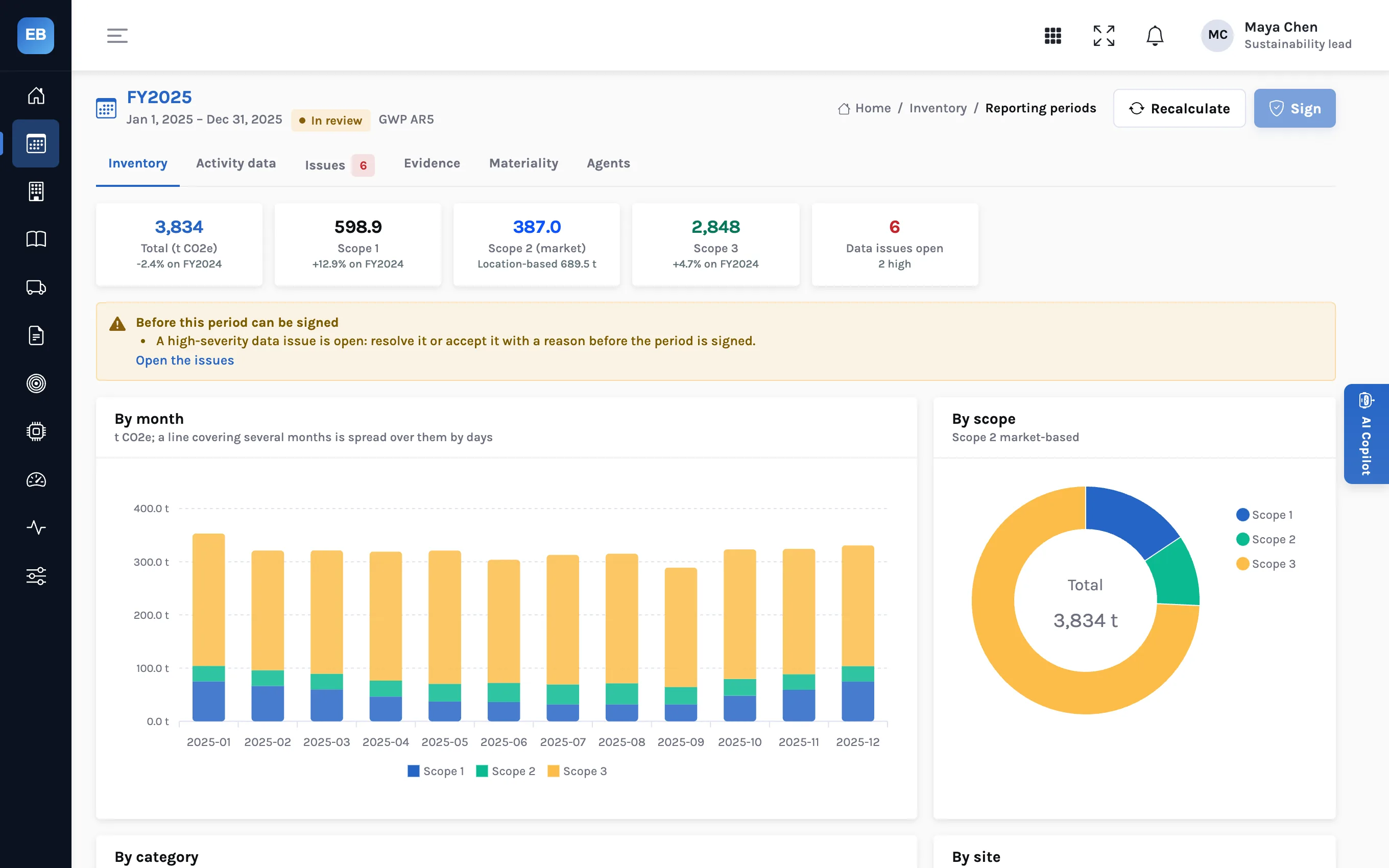
- Deal with 6 data issues.
- Ask 4 suppliers for data: Halvard, Ostrava, Pemberton and Bluefield.
- Accept 9 drafted ESRS datapoints.
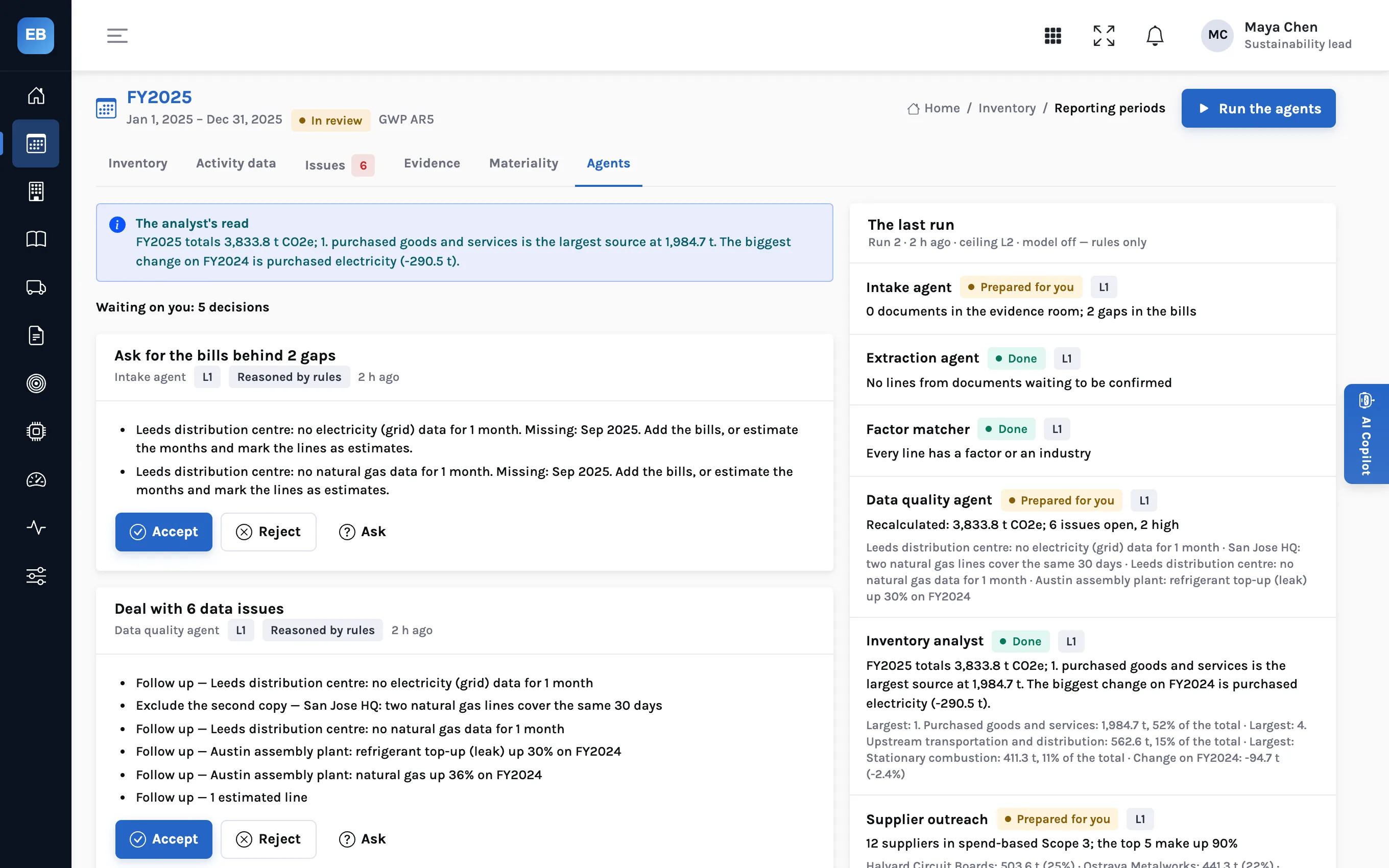
Each decision has three answers:
- Accept carries out what was prepared, for example excluding the second copy of San Jose's June gas bill and logging the follow-ups.
- Reject leaves things as they are.
- Ask lets you question the agent before deciding.
Whichever you choose, the answer goes on the decision record with who answered and when. Open a decision and you see exactly what would change.
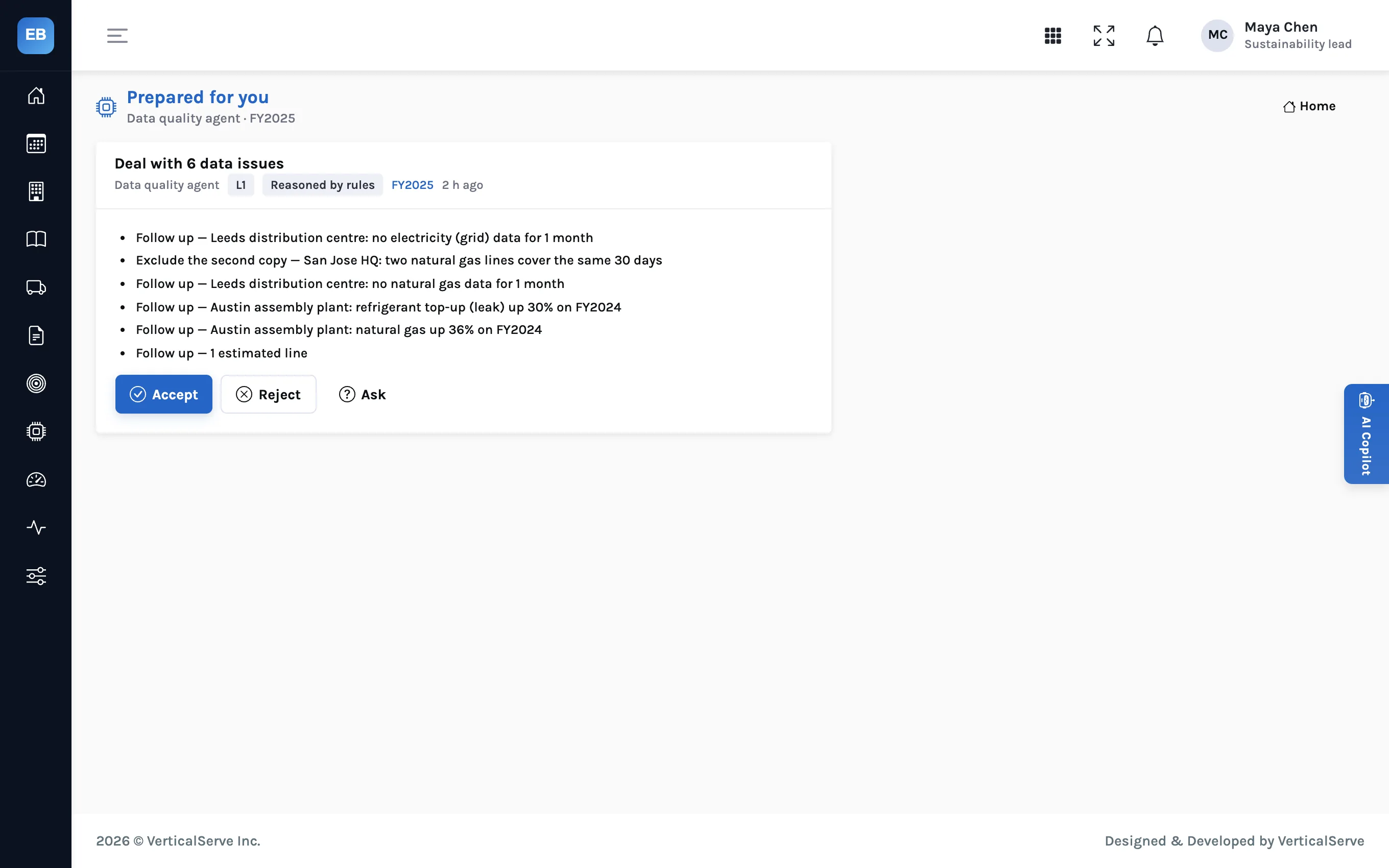
Autonomy: L1 to L4, capped at L2
Each agent and each of its actions has an autonomy level:
| Level | Name | Meaning |
|---|---|---|
| L1 | Draft | The agent drafts; a person does the rest |
| L2 | Ask first | The agent prepares the action and asks |
| L3 | Act and tell | The agent acts, then reports |
| L4 | Act | The agent acts |
In ESGBlade the ceiling for every workspace is L2, Ask first. Whatever level is set on the dial, no agent acts on its own. The dial exists so you can hold an agent lower, at L1, if you want drafts only.
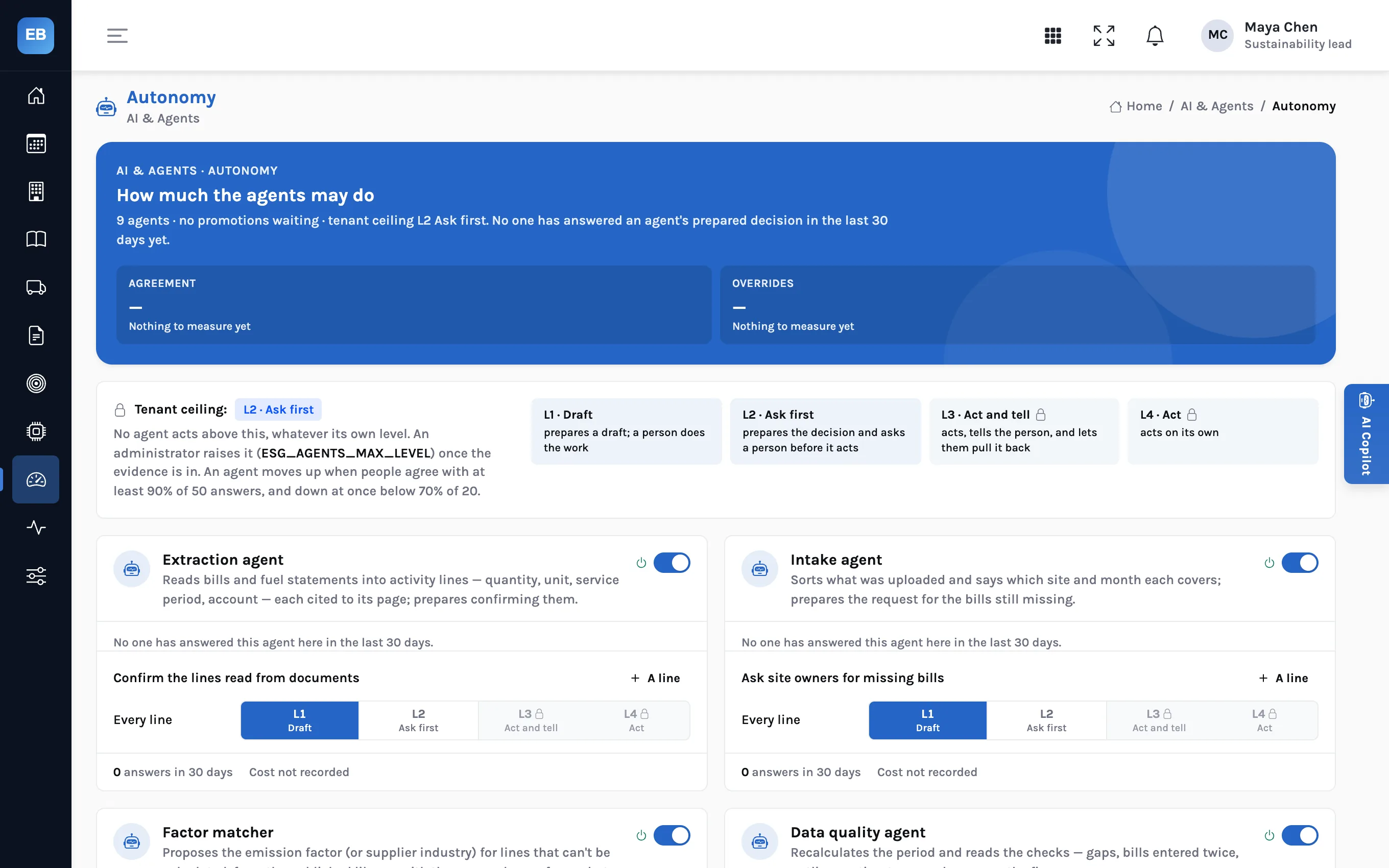
When the model is switched off
The AI model runs through AWS Bedrock when it is switched on. It can also be switched off entirely. When it is, every agent falls back to its own rules and says so. The data quality agent still finds the gap at Leeds and the duplicate at San Jose, because those checks are rules. What changes is the wording: explanations come from templates rather than drafted prose. In the agent's run trace, the cost line reads $0, rules only.
The arithmetic never depends on the model
Emissions are calculated by deterministic code whether the model is on or off. Agents read, explain and draft; they do not compute tonnes.
Grounding: numbers must come from the facts
A language model can write a sentence with a plausible number that isn't true. ESGBlade checks for that. Each agent is given the facts it may use, such as the period's totals or an issue's details. If a drafted sentence contains a number that is not in those facts, the sentence is thrown away and the rules' wording is used instead. There are tests for this behaviour.
So if the analyst writes that Scope 1 rose to 598.9 t, that figure came from the inventory. If it had written a figure the inventory doesn't contain, you would see the rules' plainer sentence instead.
The decision record
The decision record is also where the sustainability lead signs the period and approves disclosures. In the audit trail, agents appear as themselves, with their agent code and autonomy level, so a reviewer can separate what an agent proposed from what a person did. More detail is on the agents page and security.
A typical order for answering
- Read the analyst's read for the period.
- Answer the data quality decisions first, because they can change the totals.
- Send, or edit and send, the requests for missing bills and supplier data.
- Review drafted disclosure datapoints once the figures are settled.
- Let the supervisor prepare sign-off when no control blocks it.
The data quality step is covered in the missing bill and the bill entered twice, and the supplier step in asking suppliers for their own numbers.
Where people stay in charge
- Every agent stops at Ask first. No agent acts above L2. Each one prepares a decision, and a person answers Accept, Reject or Ask.
- Requests wait for a person. Supplier and site requests are held until a person sends them.
- The lead signs. The sustainability lead signs the period and approves disclosures on the decision record.
- Rules mode keeps people writing. With the model off, explanations use template wording, and narrative disclosure answers list the passages found in your evidence, marked Needs input for a person to write. Figures from the inventory are drafted either way.
The agents do the reading and the chasing. A named person makes every call that changes a number.
Try it on your own data
ESGBlade is free. Tell us about your company and we'll set up a workspace for your first reporting period.
Request a demo