Ask a general-purpose language model to answer a sustainability questionnaire and it will usually answer every question. It may write that the company is committed to net zero by a certain year, that it has a board-approved transition plan, that a share of its electricity is renewable. It writes these fluently, whether or not they are true.
In a disclosure that is the worst kind of error. It reads well, nobody questions it, and it ends up in front of a customer, a lender or a regulator as a statement the company made. ESGBlade's disclosure writer and questionnaire responder are built to avoid it. When they can't support an answer, they write [Needs input: …] and say exactly what is missing.
What is never invented
Some kinds of statement can only come from a decision the company has made. ESGBlade never drafts them from nothing:
- Targets: scopes, base year, target year, percentage. If you've set a target in ESGBlade, the draft uses it as set. If not, it asks.
- Policies and commitments: what the company has promised to do.
- Transition plans: how the company intends to cut emissions and by when.
- Carbon prices: whether you use an internal price, and at what level.
- Carbon credits and removals: what was bought, retired or claimed.
- Assurance: who checked the figures, and at what level.
- Figures that aren't in the inventory.
These are the items where a plausible guess does the most harm, because a reader can't tell a guess from a decision.
The three ways an item is drafted
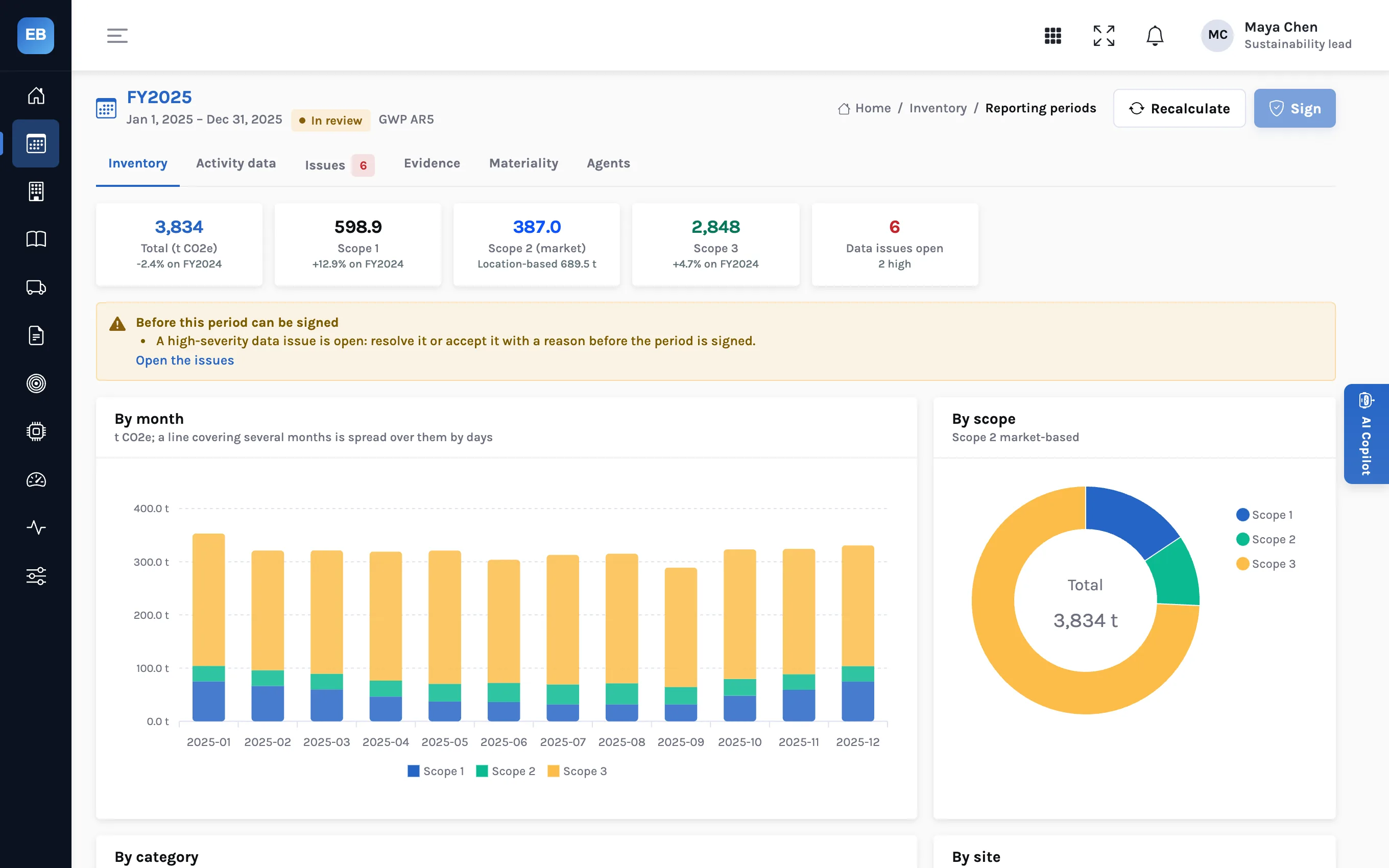
- From the inventory. If the item asks for something the inventory holds (Scope 1, Scope 2 on either basis, Scope 3 by category, the boundary, the methodology), the draft states it and is checked against the inventory. The answer shows its source: the period and the value.
- From the evidence documents. If the item is about governance, policy or risk process, the agent searches the documents you uploaded and cites the passages it found, with document name and page.
- Needs input. If neither source can answer it, the draft says what's missing. Where relevant passages exist but don't settle the question, it lists them so the person writing the answer starts from them.
Grounding: numbers have to come from the facts
When the model is switched on, it drafts sentences from a set of facts the agent gives it: figures from the inventory, passages from evidence. Then the sentence is checked. If it contains a number that isn't in the facts it was given, the sentence is thrown away and the rules' own wording is used instead. There are tests for this.
That catches the most common failure: a model rounding 387.0 to "about 400", adding a percentage it worked out itself, or filling in a year. A sentence that only restates the facts survives. A sentence with anything new in it doesn't.
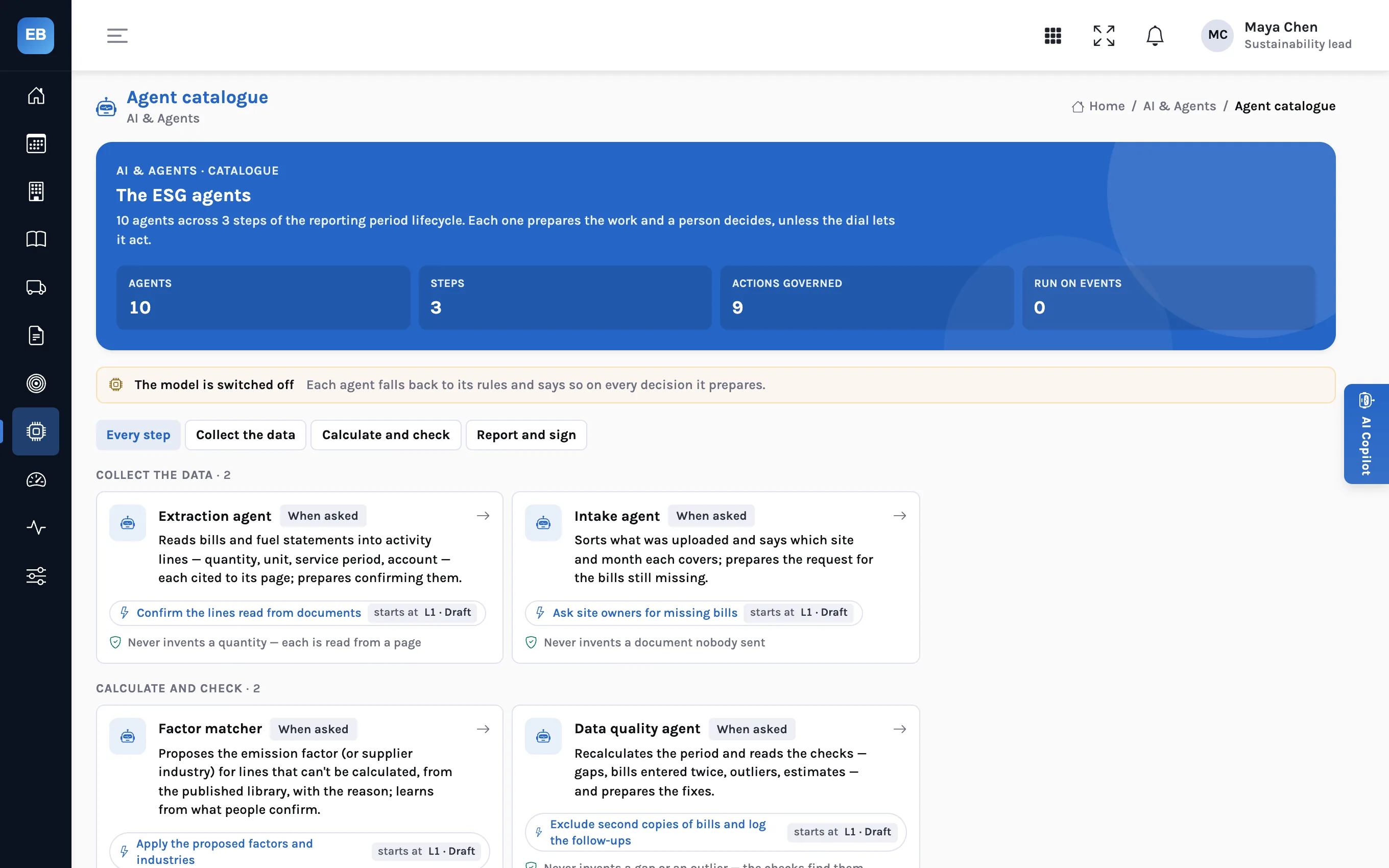
When the model is switched off, every agent falls back to its own rules and says so. The drafts are plainer, but they are drafted the same three ways, and the gaps are the same gaps.
Examples from the demo
The demo company, Cedarline Instruments, is fictional. These are drafts from its FY2025 disclosures.
The boundary, with a question attached
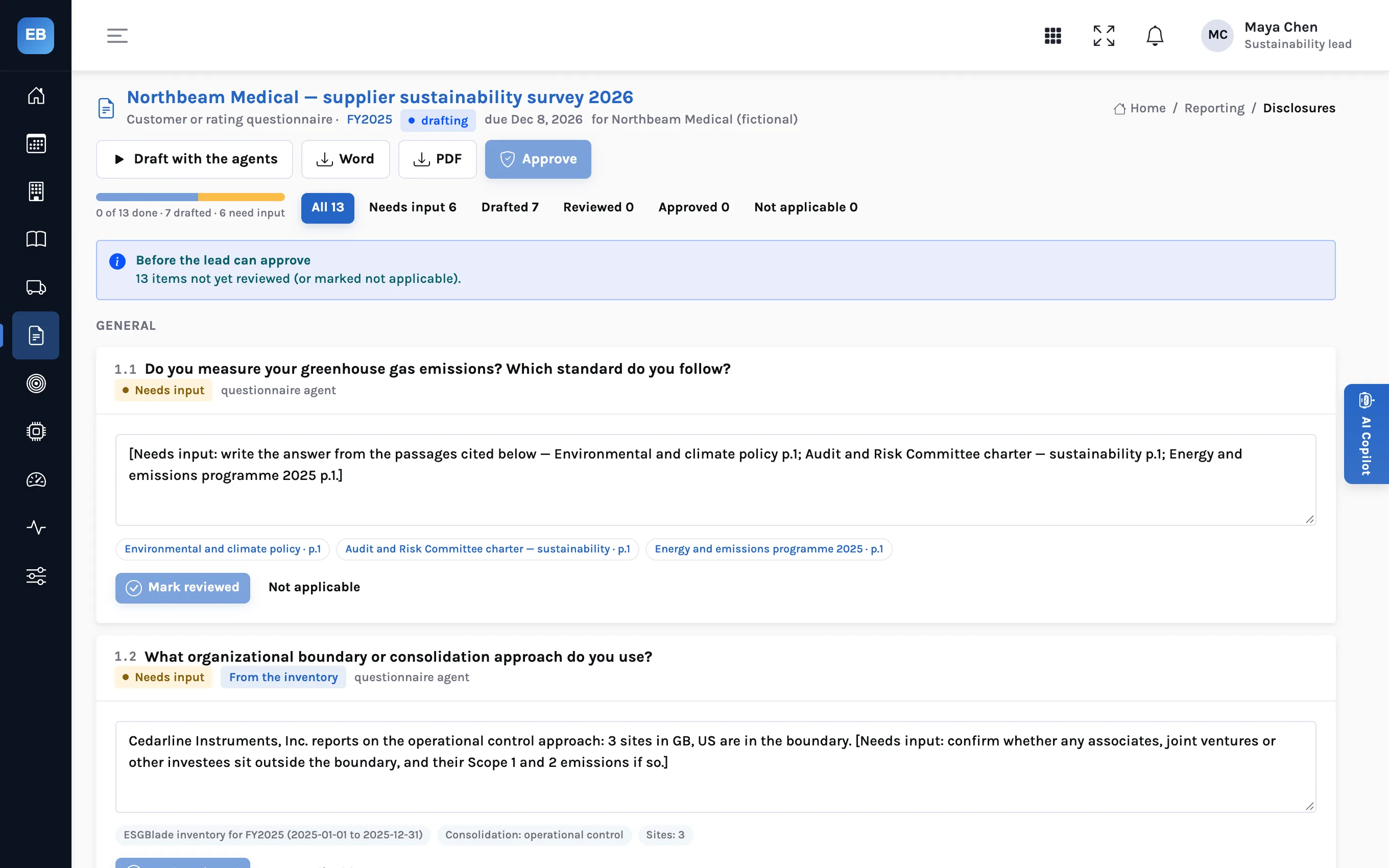
A customer questionnaire from Northbeam Medical (also fictional) asks which boundary Cedarline uses. The inventory knows: operational control, three sites in the US and the UK. So the questionnaire responder drafts that, then adds: "[Needs input: confirm whether any associates, joint ventures or other investees sit outside the boundary, and their Scope 1 and 2 emissions if so.]" The inventory only knows the entities someone entered. It can't know about one that wasn't.
The transition plan
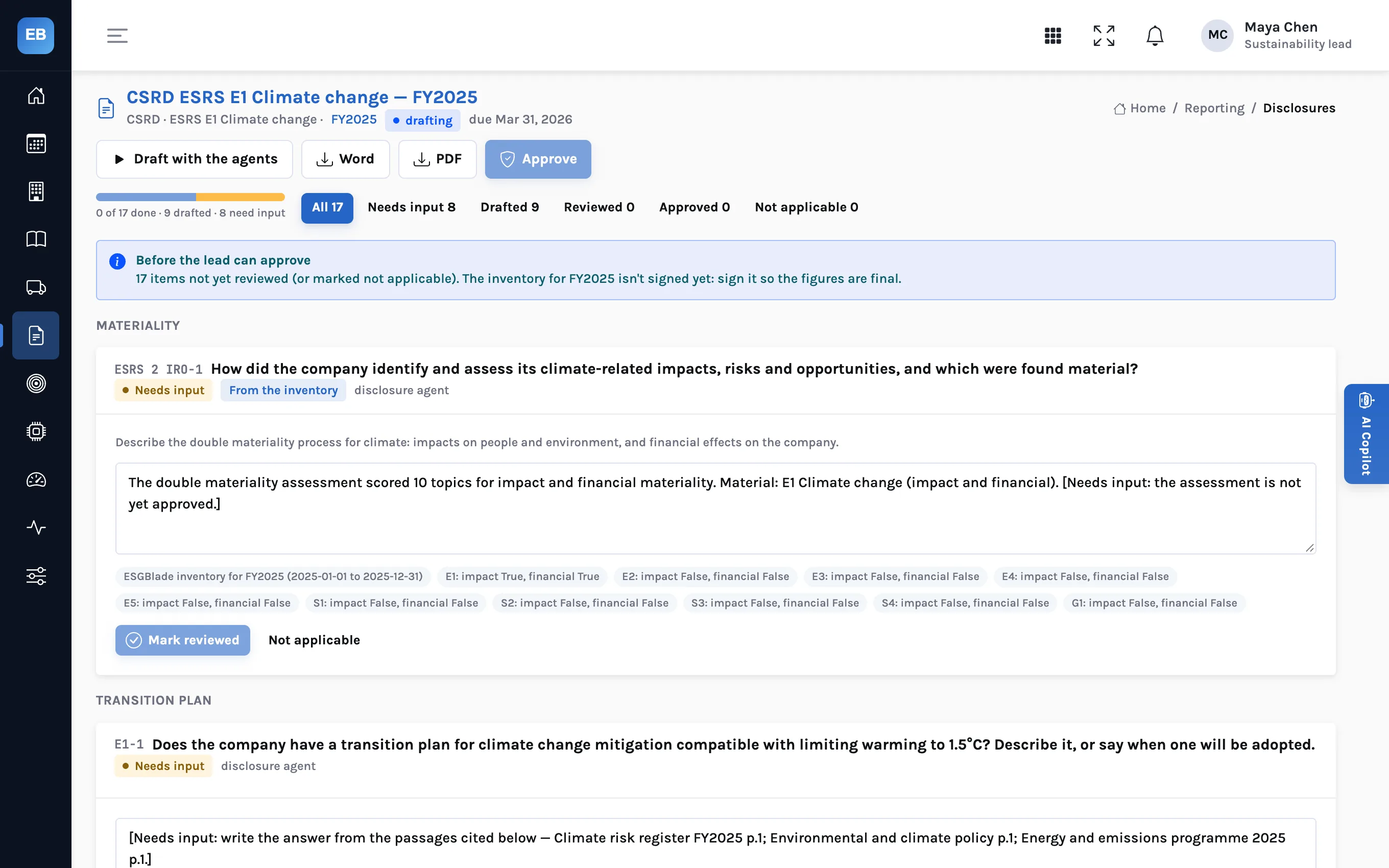
ESRS E1-1 asks whether the company has a transition plan compatible with 1.5°C. Cedarline's evidence includes a climate policy, a risk register and an energy programme, and the draft cites the relevant page of each. It doesn't write a plan from them, because a programme of projects is not a transition plan unless the company says it is.
The ETS share
E1-6 48(b) asks what share of Scope 1 falls under a regulated emissions trading scheme. The answer is zero if no site is in the EU ETS or a similar scheme, but the inventory has no field for that, so the draft asks rather than writing "0%".
Awaiting approval
The ESRS 2 IRO-1 draft states which topics the materiality assessment found material, then notes that the assessment is awaiting approval. The draft won't present an unapproved result as final.
Mark reviewed is blocked while a gap remains
Each item has Mark reviewed and Not applicable. Mark reviewed stays blocked while the text contains "[Needs input". To clear it, a person writes the answer, or marks the item not applicable if it truly doesn't apply. The lead can't approve the disclosure until every item is reviewed or not applicable, so a placeholder can't reach an exported Word or PDF file by accident.
| Draft | What a person does | Can it be marked reviewed? |
|---|---|---|
| Figure from the inventory | Checks it against the inventory | Yes |
| Cited passages | Reads them, edits the wording | Yes |
| Figure plus [Needs input: …] | Confirms the point, removes the note | Once the note is gone |
| [Needs input: …] only | Writes the answer, or marks Not applicable | Not until it's replaced |
A long list of gaps is useful
Eight items needing input on ESRS E1 isn't a failure of the draft. It's an accurate list of the decisions the company still has to write down, and who needs to make them.
Where people stay in charge
- Your company decides. Targets, policies and commitments come from decisions your company has made; where none is written down, the item says Needs input.
- A person reads every draft. Grounding removes numbers that aren't in the facts, and a person reads each draft for meaning and wording.
- Your documents are the evidence. Drafts cite the documents your team uploads, by document and page.
- Your people review and approve. The lead approves on the decision record, and your assurance provider gives assurance.
More on the approach in agents prepare, people decide and on the agents page; the full questionnaire walk-through is in answering a customer's sustainability questionnaire.
A clear gap is safer than a confident sentence nobody decided.
Try it on your own data
ESGBlade is free. Tell us about your company and we'll set up a workspace for your first reporting period.
Request a demo