A reduction target is easy to announce and hard to follow. "42% by 2030" fits on a slide. What a board, a lender or a customer will ask next is less tidy: 42% of what, from when, are you on track this year, how much is still to cut, and what are you actually doing about it?
This post explains the parts of an absolute target and how ESGBlade tracks one, using the fictional demo company Cedarline Instruments. It also shows where people stay in charge: ESGBlade calculates progress, and your team judges whether the target is ambitious enough.
The parts of an absolute target
| Part | What it is | Cedarline's choice |
|---|---|---|
| Scopes | Which emissions the target covers: Scope 1+2, Scope 3, or 1+2+3 | Scope 1 and 2 |
| Base year | A calculated period whose total becomes the starting value | FY2024, 1,208.1 t |
| Target year | The year the reduction should be reached | 2030 |
| Reduction | The percentage cut from the base value | 42% |
| Target value | Base value × (1 − reduction) | 700.7 t |
An absolute target is a cut in tonnes, regardless of growth. An intensity target is a cut per unit of output or revenue, which can be met while total emissions rise. ESGBlade tracks absolute targets, measured in tonnes.
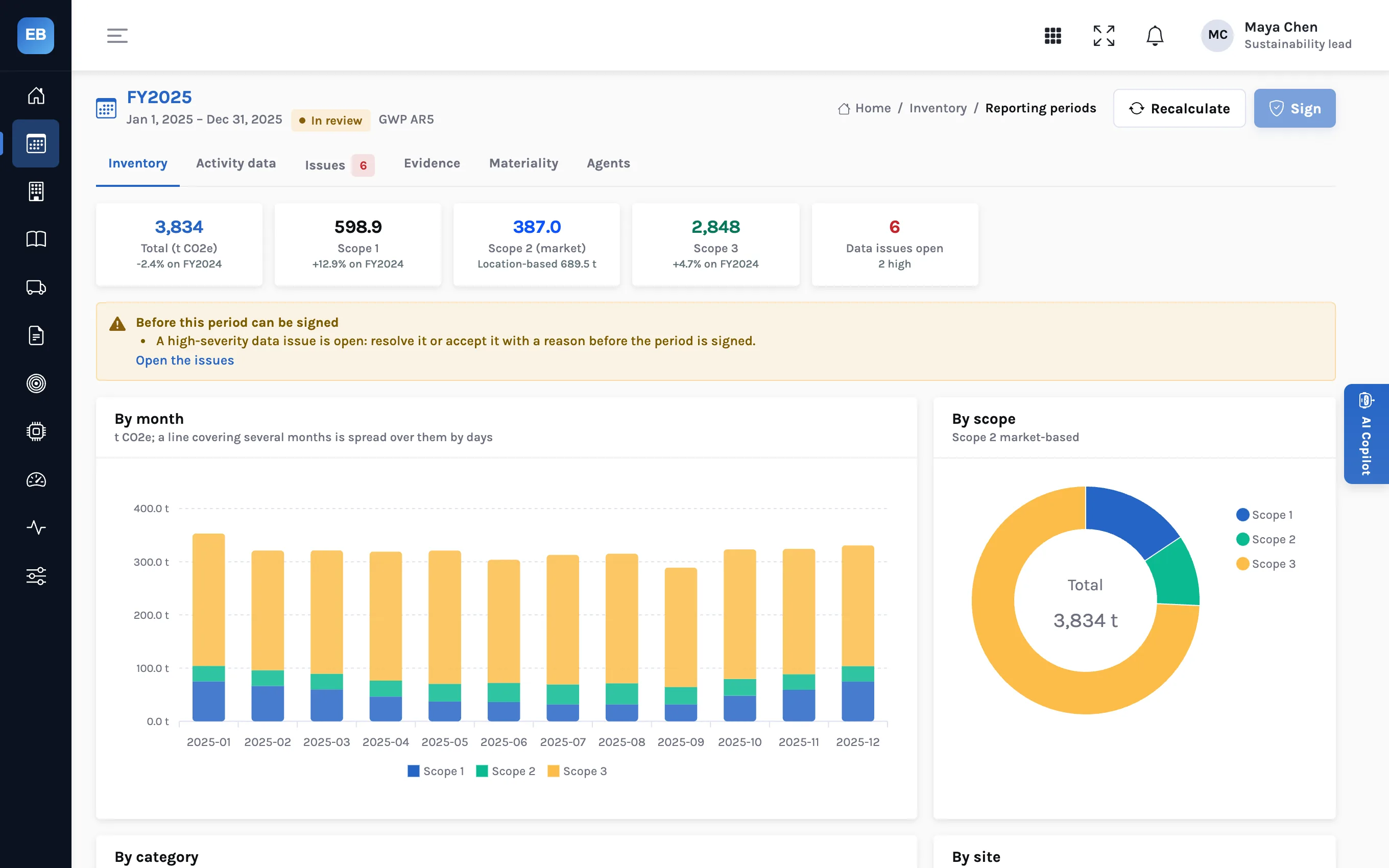
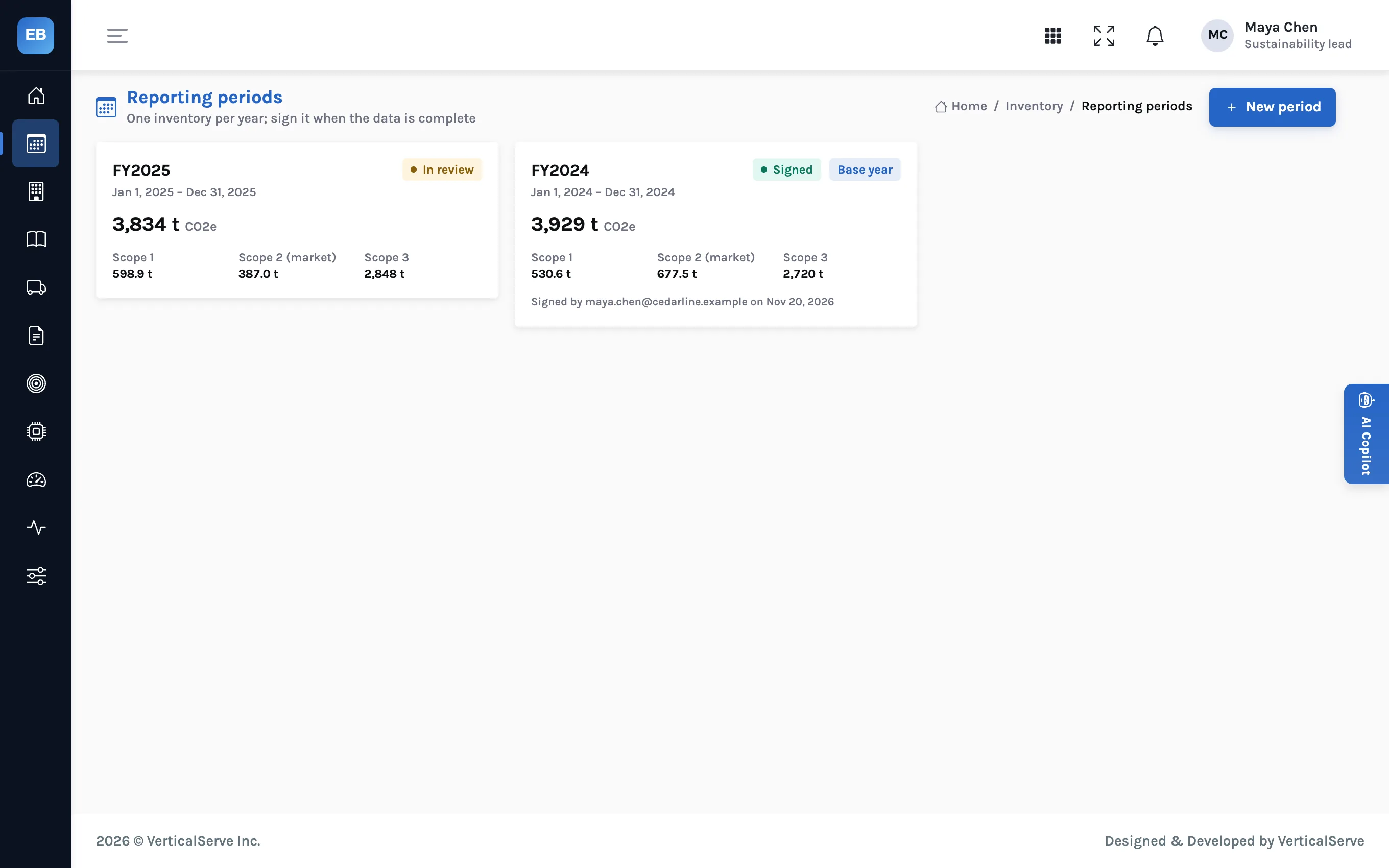
The base year should be a period you trust. Cedarline's FY2024 is signed, and is marked as the base year in its reporting periods. Its Scope 1 was 530.6 t and Scope 2 was 677.5 t, so the base value for a Scope 1 and 2 target is 1,208.1 t.
The pathway
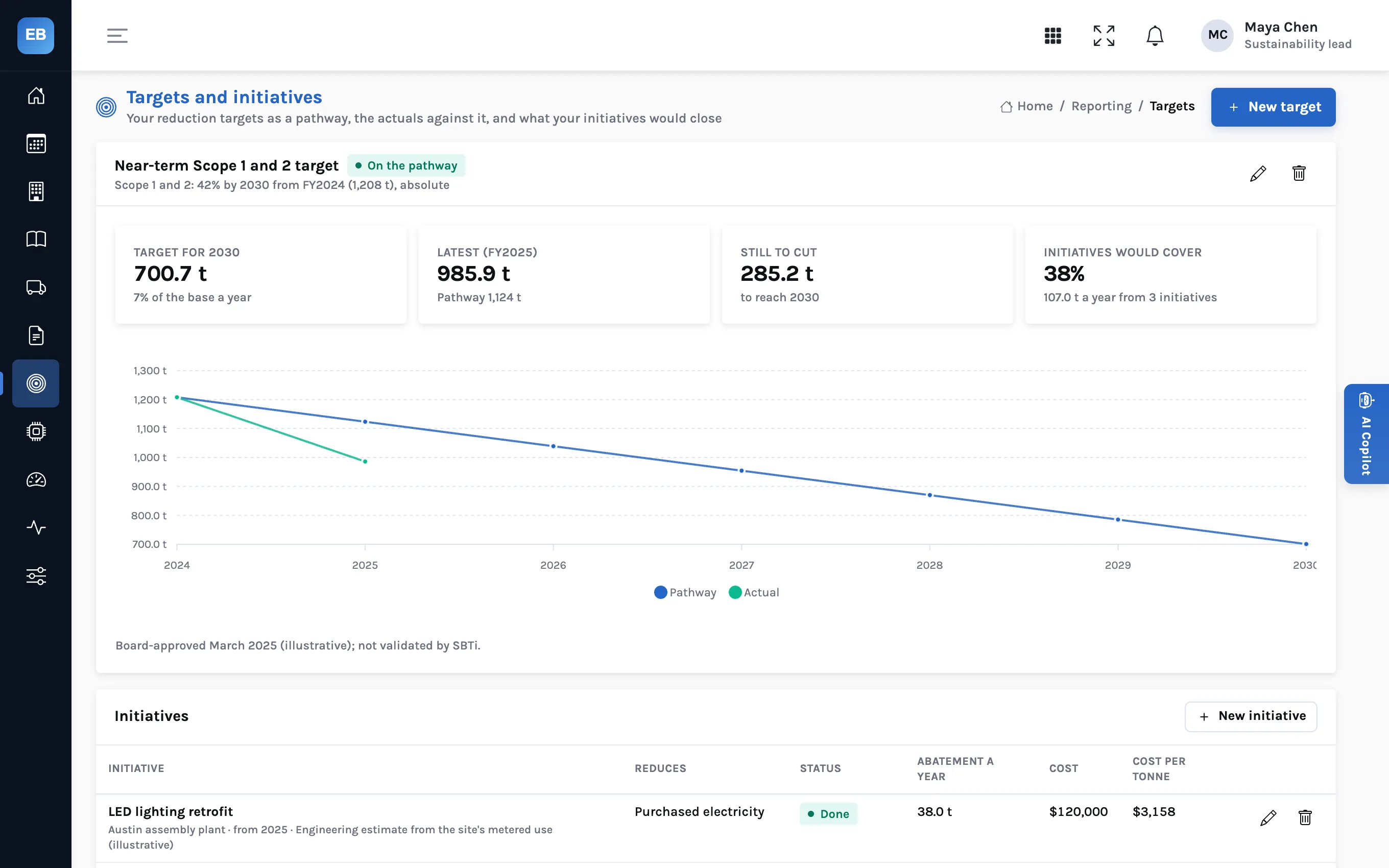
ESGBlade draws a straight line from the base value in the base year to the target value in the target year. For Cedarline, a 42% cut over six years is 7% of the base each year, about 84.6 t. That line is the pathway. Each period's actual total is compared with the pathway value for that year: on the pathway if it is at or below the line, above if not.
A straight line is a simple, transparent assumption. Real reductions come in steps, when a project finishes, so a company can be above the line one year and below it the next.
Step by step in ESGBlade
- Make sure the base year period is calculated, ideally signed.
- Open Targets and add a target: choose the scopes, the base year, the target year and the percentage.
- ESGBlade takes the base year's total as the base value and works out the target value and the pathway.
- Each later period, once calculated, is plotted against the pathway and marked on or above.
- Add initiatives with their estimated abatement, and see how much of the remaining gap they would cover.
Where Cedarline stands after FY2025
FY2025's Scope 1 and 2 total is 985.9 t: Scope 1 of 598.9 t plus market-based Scope 2 of 387.0 t. The pathway value for FY2025 is 1,123.5 t, so Cedarline is on the pathway.
Read the reason behind the progress
Most of Cedarline's FY2025 fall comes from the Texas wind RECs that lowered market-based Scope 2. Scope 1 rose. A target on market-based Scope 2 can be met partly through procurement, and readers will want to know that. See location-based and market-based Scope 2.
The figure to watch is still to cut: the gap between the latest actual and the target value. For Cedarline, 985.9 t − 700.7 t = 285.2 t.
Initiatives and the gap
An initiative is a project expected to reduce emissions. Each records what it reduces (the category), the site, a status (idea, planned, in progress or done), its estimated abatement, its cost, the cost per tonne and an owner. An estimate of abatement is only accepted with a note on how it was estimated, so the number has a basis someone can question.
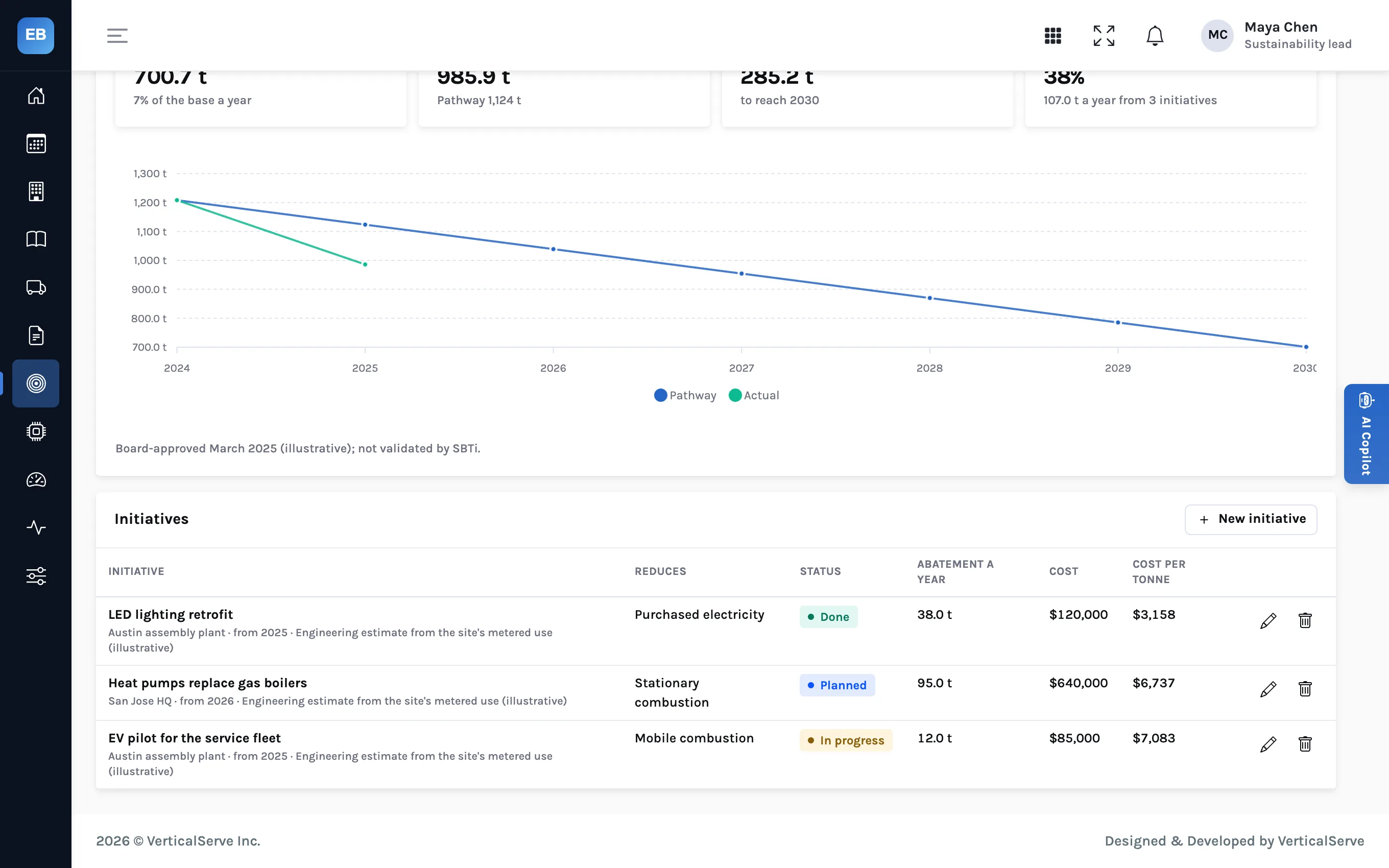
| Initiative | Status | Estimated abatement | Cost | Cost per tonne |
|---|---|---|---|---|
| LED lighting retrofit | Done | 38 t | $120,000 | $3,158 |
| Heat pumps | Planned | 95 t | $640,000 | $6,737 |
| EV pilot | In progress | 12 t | $85,000 | $7,083 |
ESGBlade compares the open initiatives with the gap. Heat pumps (95 t) and the EV pilot (12 t) together would cover 107 t of the 285.2 t still to cut, which is 38%. The LED retrofit is done, so its effect is expected in the actuals rather than counted again as future abatement.
Cost per tonne is cost divided by estimated abatement. It is a rough way to rank options, not an investment case: it leaves out energy savings, timing and the life of the asset.
- Coverage below 100% means the current plan does not reach the target. That is common and worth saying.
- Coverage counts every open initiative that has an abatement estimate, ideas included. Keep statuses current so the figure reflects the real plan.
Targets in disclosures
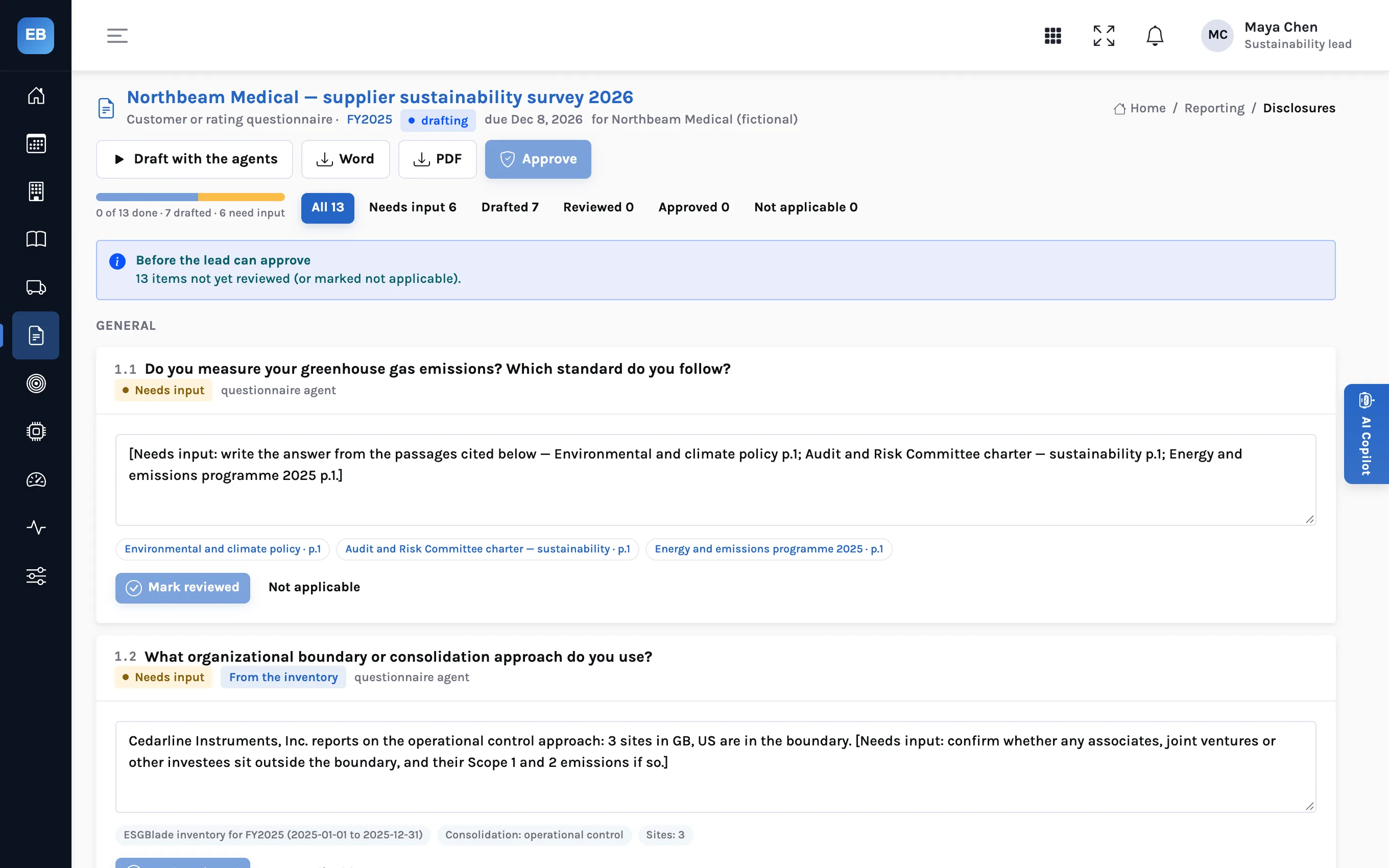
Frameworks such as ESRS E1 ask about targets. ESGBlade never invents a target, a commitment or a transition plan in a disclosure draft; where one is needed and none is recorded, the item says Needs input. Cedarline's target carries the note "Board-approved March 2025 (illustrative); not validated by SBTi", and the approval history is yours to state. See frameworks.
Where people stay in charge
- Your team sets the target. ESGBlade calculates the pathway and each year's progress; your team decides the target, judges its ambition and states its approval history.
- A signed base. The base year is a period the lead signed on the decision record.
- Estimates carry their basis. Initiative abatement is entered by its owner with a note on how it was estimated, so the number has a basis someone can question.
- Targets in disclosures come from you. Where a framework asks for a target and none is recorded, the item says Needs input for a person to fill.
The base year comes from the inventory itself; see Scope 1, 2 and 3 from the bills you already have.
A target you can track has a signed base, a line to measure against, and projects with a stated basis for what they'll cut.
Try it on your own data
ESGBlade is free. Tell us about your company and we'll set up a workspace for your first reporting period.
Request a demo