ESRS E1 is the climate standard under the EU's Corporate Sustainability Reporting Directive (CSRD). It asks for emissions figures, but most of its items are about what the company has decided: a transition plan, policies, targets, an internal carbon price, the financial effects of climate risk. A mid-sized company can usually produce the figures. The decisions take longer.
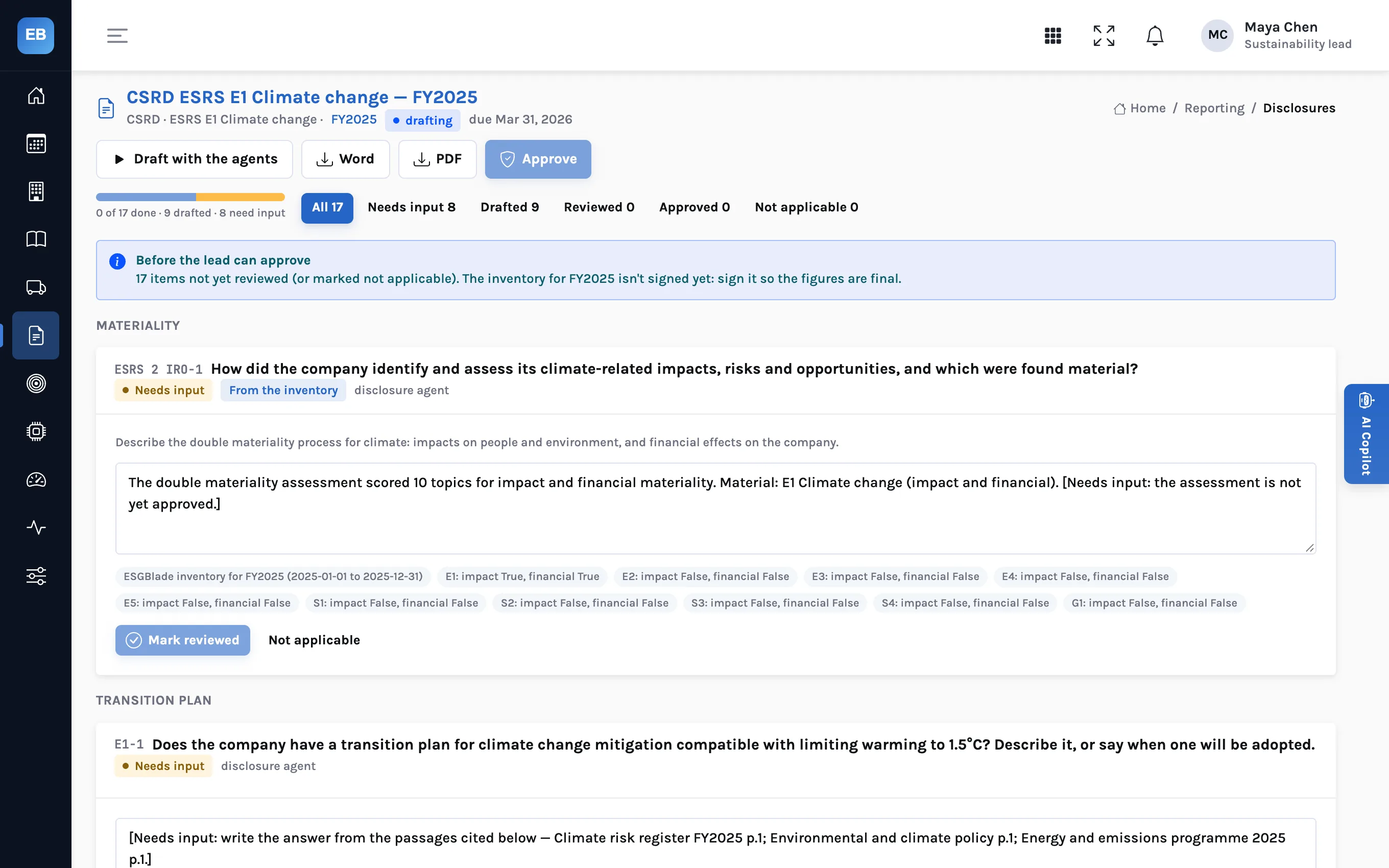
This post goes through the 17 items ESGBlade drafts for E1, says which come from the inventory and which need people, and shows the demo company's FY2025 draft: 9 items drafted, 8 needing input.
First: check whether you are in scope
CSRD's scope has been changing. Since 2025 the EU's "Omnibus" simplification has delayed reporting for many companies and narrowed who must report, and the ESRS themselves are being simplified. Thresholds and dates in older guidance may no longer apply. Check the current rules for your company with your advisers before you plan a CSRD report.
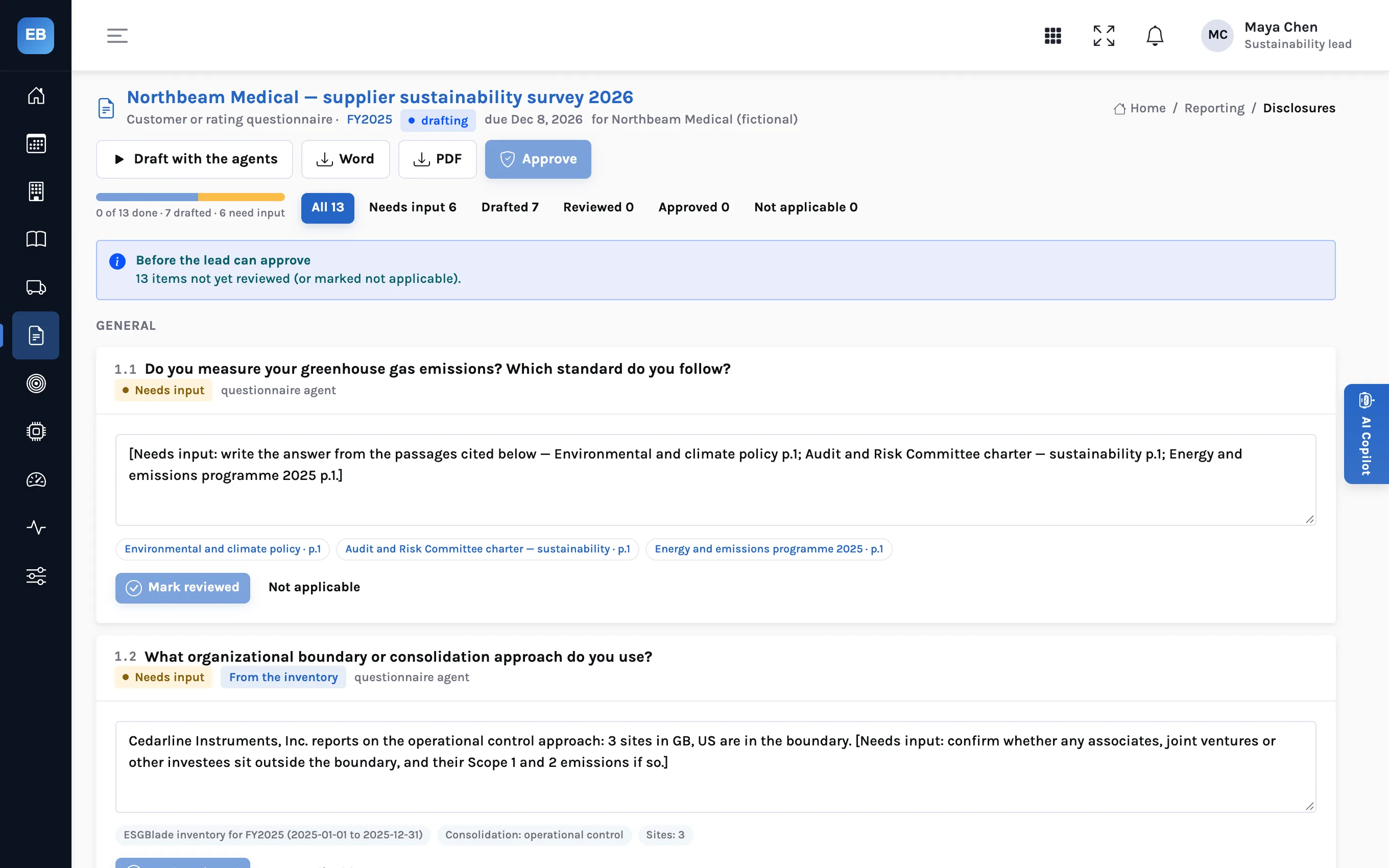
Even if you are out of scope, E1 may still reach you. Large customers that report under CSRD need data from their value chain, and many send suppliers questions phrased in ESRS terms: gross Scope 1, location- and market-based Scope 2, Scope 3 by significant category, a transition plan. Preparing E1-style answers once is often the quickest way to answer those requests. See answering a customer's sustainability questionnaire.
Not legal advice
ESGBlade helps you prepare disclosure text from your own data. It doesn't decide whether CSRD applies to you, provide assurance, or file anything.
Materiality comes first
Under ESRS you report on a topic because your double materiality assessment found it material. ESRS 2 IRO-1 asks how you identified and assessed climate impacts, risks and opportunities, and which were material. So the assessment has to exist, and be approved, before E1 makes sense.
In ESGBlade the materiality assistant proposes the E1 scores from the inventory, the team scores the ten topics, and the lead approves. In the demo, E1 Climate change is material on both sides (impact 3.67, financial 3.2). Until the lead approves, the IRO-1 answer carries a note: "[Needs input: the assessment is not yet approved.]" The scoring is explained in double materiality, scored topic by topic.
The 17 items, and where each answer comes from
| Item | What it asks | Source in ESGBlade |
|---|---|---|
| ESRS 2 IRO-1 | How climate impacts, risks and opportunities were assessed; which are material | From the materiality assessment |
| E1-1 | Transition plan compatible with 1.5°C, or when one will be adopted | Needs a person; cited passages offered |
| E1-2 | Policies for mitigation and adaptation | From evidence, if a policy is uploaded |
| E1-3 | Actions and resources | From initiatives entered; people add resources |
| E1-4 | GHG reduction targets | From targets set; never invented |
| E1-5 | Energy consumption and renewable share | From the inventory |
| E1-6 | Gross Scope 1; Scope 2 location and market; Scope 3 by category; totals | From the inventory |
| E1-6 48(b) | Share of Scope 1 under regulated emissions trading | Needs a person |
| E1-6 53 | GHG intensity per net revenue | From the inventory and revenue |
| E1-6 method | Boundary, consolidation approach, factors and GWPs | From the inventory set-up |
| E1-7 | Removals and carbon credits | Needs a person; never invented |
| E1-8 | Internal carbon price | Needs a person; never invented |
| E1-9 | Anticipated financial effects (phase-in allowed in the first year) | Needs a person |
E1-6 accounts for eight of the 17 items: Scope 1, the ETS share, Scope 2 location-based and market-based, Scope 3 by significant category, total emissions on both bases, intensity, and methodology. Seven of those eight come straight from the inventory.
What the inventory supplies
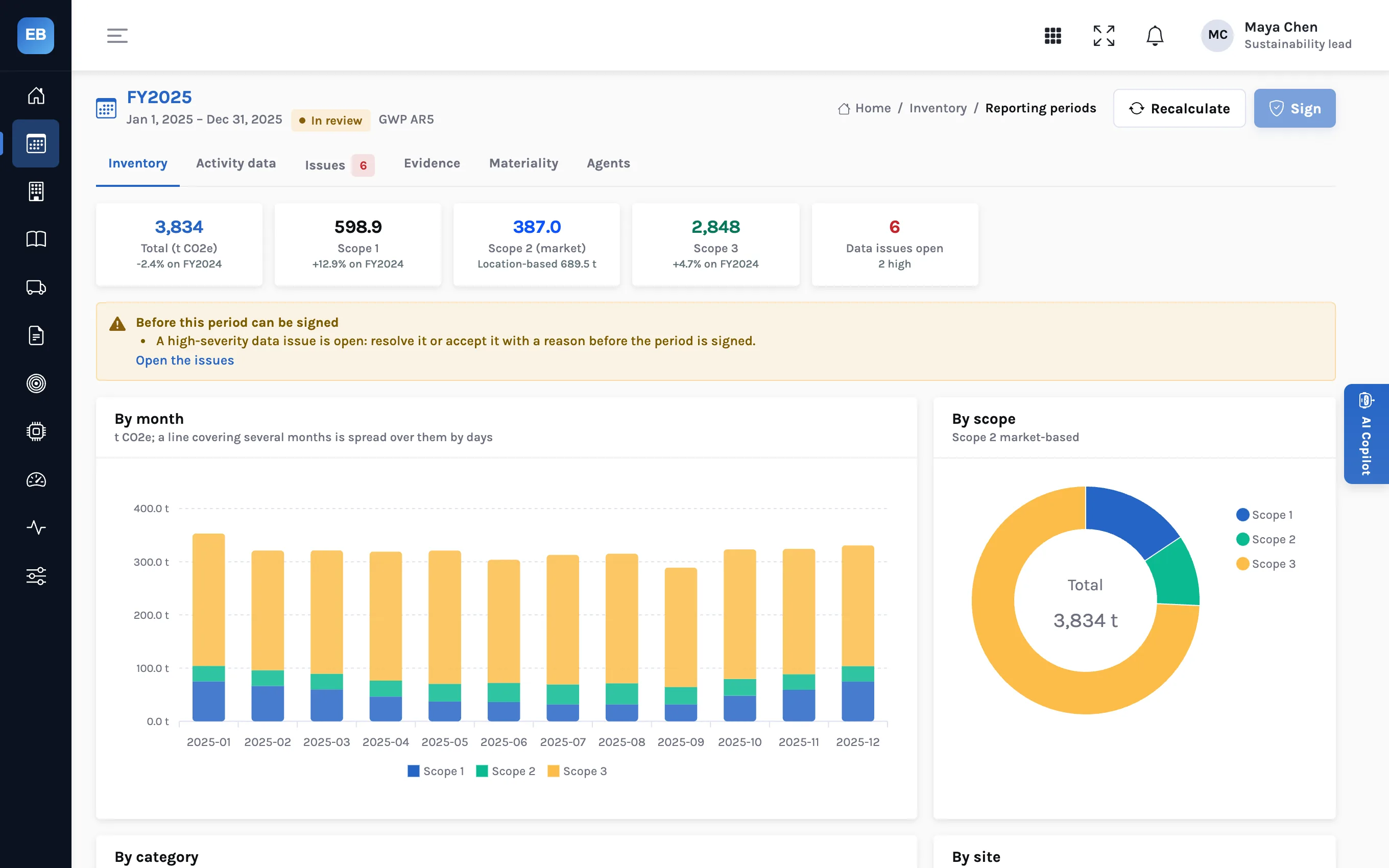
For Cedarline's FY2025, the drafted figures are gross Scope 1 of 598.9 t CO2e, location-based Scope 2 of 689.5 t, market-based Scope 2 of 387.0 t (the difference is Texas wind RECs for the Austin plant), and Scope 3 of 2,848.0 t across five categories. Each draft shows the inventory period and the value it was checked against.
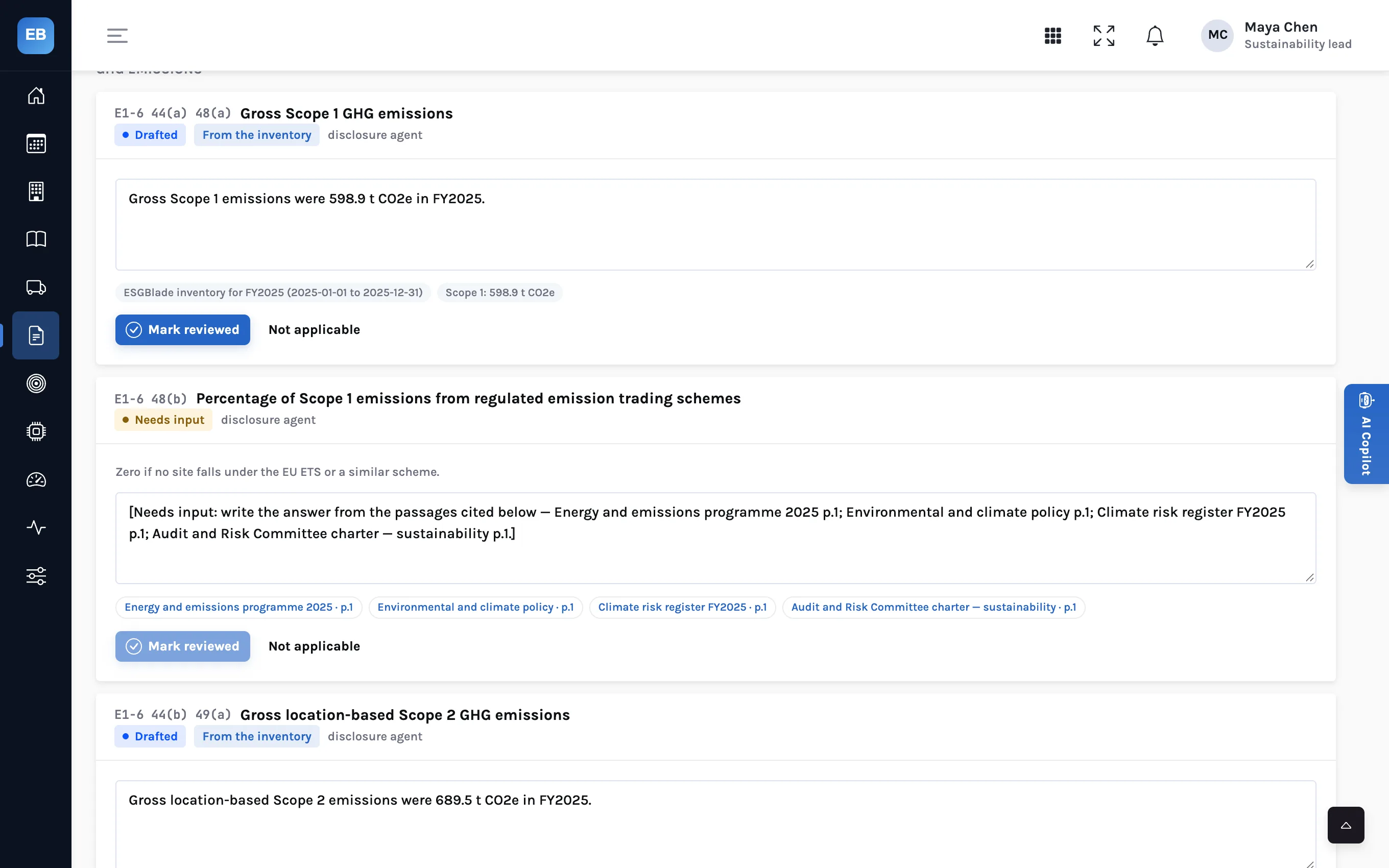
The ETS item is a good example of a small question that still needs a person. None of Cedarline's sites may be in an emissions trading scheme, which would make the answer zero, but the inventory has no field that records this. So the draft asks.
What needs people
The transition plan (E1-1), policies (E1-2), carbon credits (E1-7), internal carbon price (E1-8) and financial effects (E1-9) are statements of what the company has decided or expects. ESGBlade never drafts these from nothing. Where an uploaded document covers the topic, the draft points to the passages, with document and page, so the person writing the answer starts from what the company has already approved.
Step by step in ESGBlade
- Complete and approve the double materiality assessment for the period.
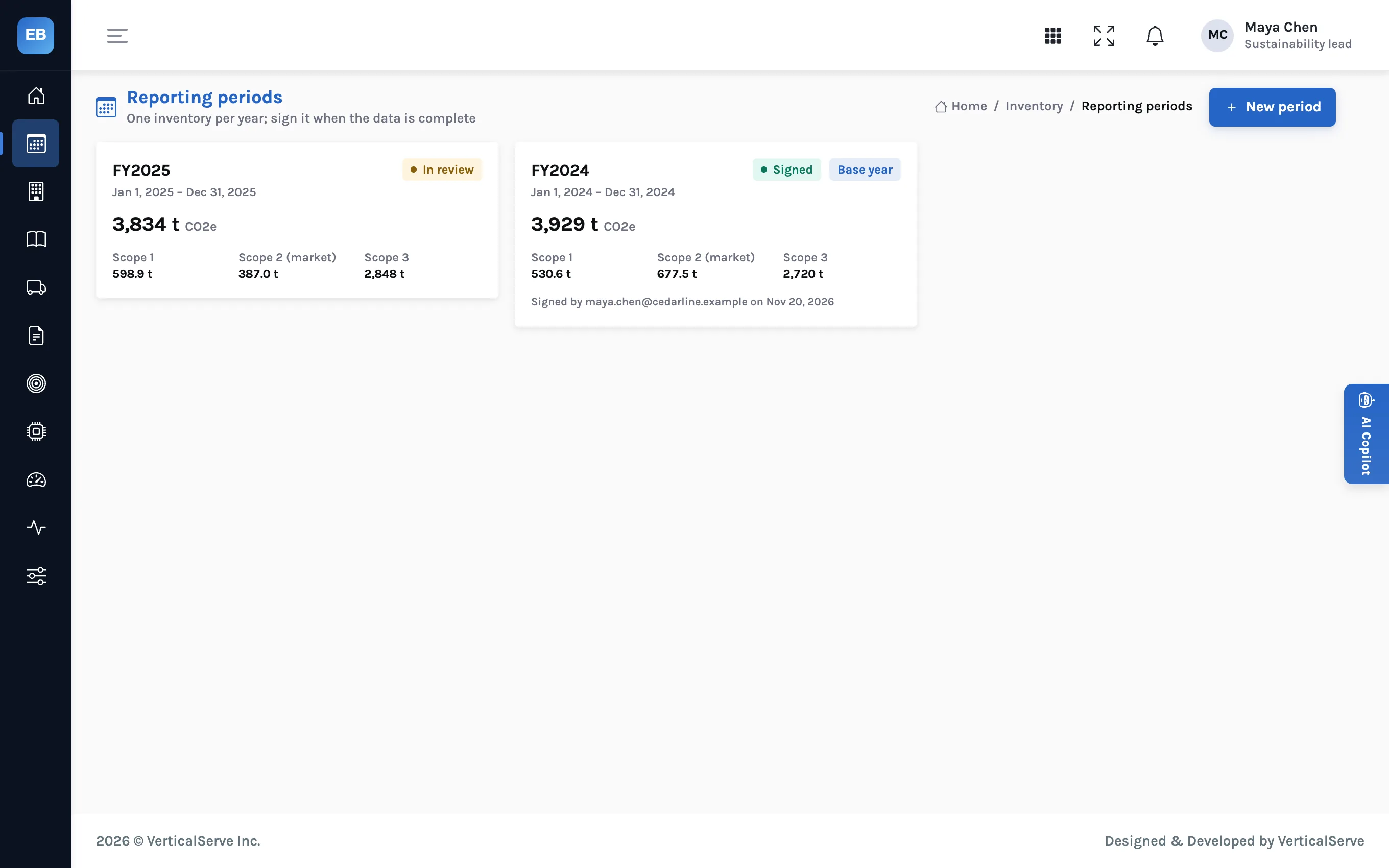
- Resolve the period's data issues and have the lead sign the inventory. Cedarline's FY2025 is still in review, so its E1 page shows the warning that the inventory isn't signed.
- Upload the documents the narrative items depend on: climate policy, risk register, board or committee charter, energy programme.
- Open the disclosure and press Draft with the agents.
- Assign the Needs input items to the people who own those decisions. Mark reviewed stays blocked until the placeholder is replaced.
- When every item is reviewed or not applicable, and the inventory is signed, the lead presses Approve. Export to Word or PDF for your report.
Where people stay in charge
- Your team sets materiality. The materiality assistant proposes the E1 scores; the team scores the ten topics and the lead approves the assessment.
- Decisions stay with the company. The transition plan, policies, carbon credits, internal carbon price and financial effects are written by people; ESGBlade marks them Needs input and offers cited passages.
- The lead approves on the decision record. Approval follows a signed inventory and every item reviewed or marked not applicable.
- You file; your assurance provider assures. ESGBlade exports Word and PDF. The company decides whether CSRD applies and files its report, and its assurance provider gives assurance.
For the agents that prepare these drafts, see the agents; for how the market-based figure is built, see location-based and market-based Scope 2.
Let the inventory answer the figures, and give the decisions to the people who make them.
Try it on your own data
ESGBlade is free. Tell us about your company and we'll set up a workspace for your first reporting period.
Request a demo