A double materiality assessment decides which sustainability topics a company reports on under the European Sustainability Reporting Standards (ESRS). It is the step that comes before any disclosure, and it is easy to do badly: a workshop, a heat map, and a list of material topics nobody can explain a year later.
This post explains the two questions the assessment asks, then shows how ESGBlade scores each topic with fixed, visible arithmetic, using the demo company's FY2025 assessment.
Two questions about every topic
Impact materiality looks outward. Does the company have, or could it have, a significant effect on people or the environment through this topic, in its own operations or its value chain? ESRS judges the severity of an impact by its scale (how grave), its scope (how widespread) and its irremediable character (how hard to undo), and, for potential impacts, its likelihood.
Financial materiality looks inward. Could the topic affect the company's cash flows, performance, position, cost of capital or access to finance? That is judged by the magnitude of the financial effect and its likelihood.
A topic is material if it is material on either side. A company can have a large impact on something that barely touches its finances, or the reverse; both are reported.
The standard sets the questions, not the numbers
ESRS describes what to consider but doesn't prescribe a scoring formula or threshold. The formulas below are ESGBlade's method. Whatever method you use, write it down so you can explain each result, and agree the threshold before you score.
The ten topics
ESGBlade scores the ten topical standards: E1 Climate change, E2 Pollution, E3 Water and marine resources, E4 Biodiversity and ecosystems, E5 Resource use and circular economy, S1 Own workforce, S2 Workers in the value chain, S3 Affected communities, S4 Consumers and end-users, and G1 Business conduct. Each gets six scores from 1 to 5: scale, scope, irremediability and likelihood for impact; magnitude and likelihood for the financial side.
The arithmetic
| Score | Formula | Material at |
|---|---|---|
| Impact | mean(scale, scope, irremediability) × likelihood ÷ 5 | 3.0 or more |
| Financial | magnitude × likelihood ÷ 5 | 3.0 or more |
| Topic | Material if either score is material | — |
Dividing by 5 keeps both scores on the same 1 to 5 scale as the inputs. A topic scored 5 on every severity measure with likelihood 5 scores 5.0; the same topic with likelihood 3 scores 3.0, exactly on the line. Likelihood pulls a severe but unlikely impact down, which is the intent.
Climate, worked through
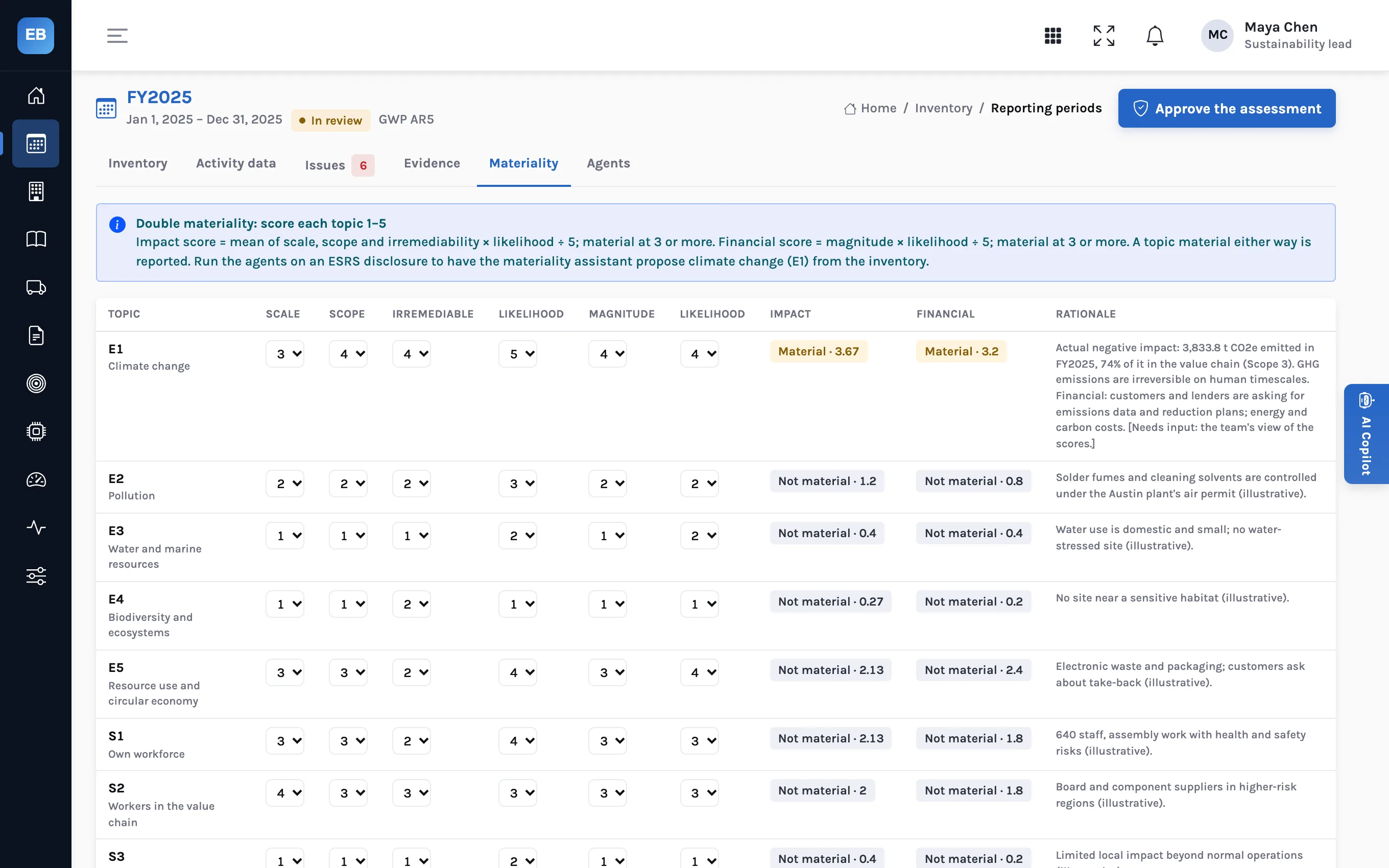
For Cedarline's E1 Climate change the team's scores were scale 3, scope 4, irremediability 4 and likelihood 5 on the impact side, and magnitude 4 and likelihood 4 on the financial side.
- Impact: the mean of 3, 4 and 4 is 3.67; times 5 ÷ 5 gives 3.67. Material.
- Financial: 4 × 4 ÷ 5 = 3.2. Material.
Compare E5 Resource use and circular economy, which the team scored 3, 3, 2 with likelihood 4 for impact (2.13) and 3 with likelihood 4 for financial (2.4). Not material on either side, though close enough that the rationale matters: electronic waste, packaging, customers asking about take-back. A topic near the line deserves a sentence on why it fell where it did.
Where the materiality assistant helps, and where it stops
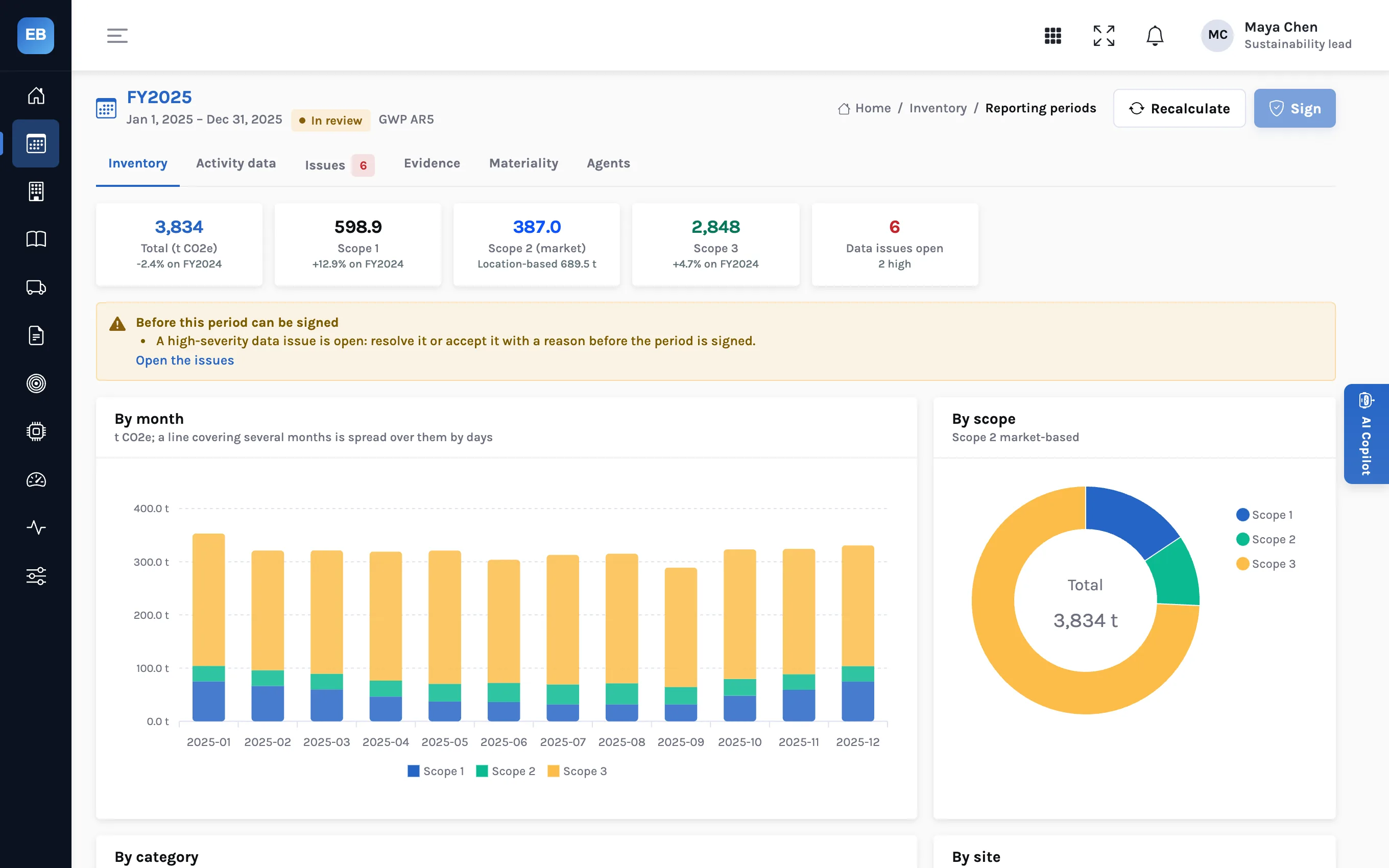
When you run the agents on an ESRS disclosure, the materiality assistant proposes the E1 scores from the inventory. Its rationale for Cedarline uses figures the inventory holds: 3,833.8 t CO2e in FY2025, about three quarters of it in the value chain (Scope 3), and the fact that customers and lenders are asking for emissions data and reduction plans. It closes with "[Needs input: the team's view of the scores.]"
That last part is deliberate. The assistant proposes; it doesn't decide. It only proposes climate, because climate is the topic the inventory measures. The other nine topics are scored by your team, from what it knows about pollution permits, water use, the workforce and the supply chain. The rationales on those rows in the demo are illustrative.
Step by step
- Open the reporting period and go to the Materiality tab.
- Run the agents on the period's ESRS disclosure so the materiality assistant proposes E1. Review its proposed scores and rationale, and change any score the team disagrees with.
- Score the other nine topics as a team. Write a one- or two-sentence rationale for each, especially for topics close to 3.0.
- Check the results. If a result surprises you, look at the inputs before changing the threshold.
- The sustainability lead presses Approve the assessment.
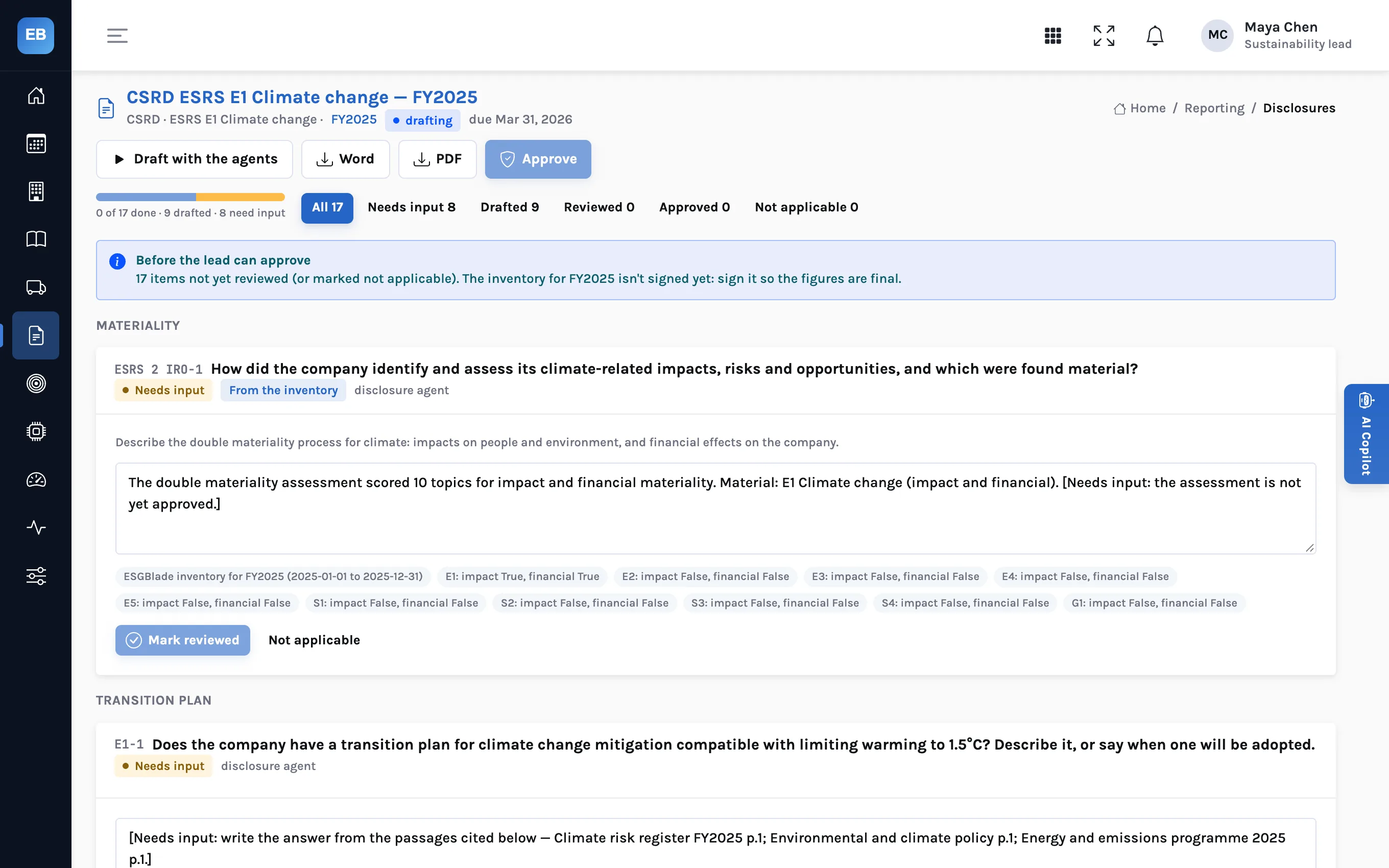
- Draft the ESRS E1 disclosure. The ESRS 2 IRO-1 item draws on the approved assessment; until it's approved, the draft says "[Needs input: the assessment is not yet approved.]"
Where people stay in charge
- The assistant proposes, the team scores. The materiality assistant proposes E1 from the inventory; your team scores all ten topics, with a rationale for each.
- Stakeholders in the rationale. Your team records what stakeholders told it in each topic's rationale.
- The lead approves. The sustainability lead presses Approve the assessment, and the IRO-1 item waits for that approval.
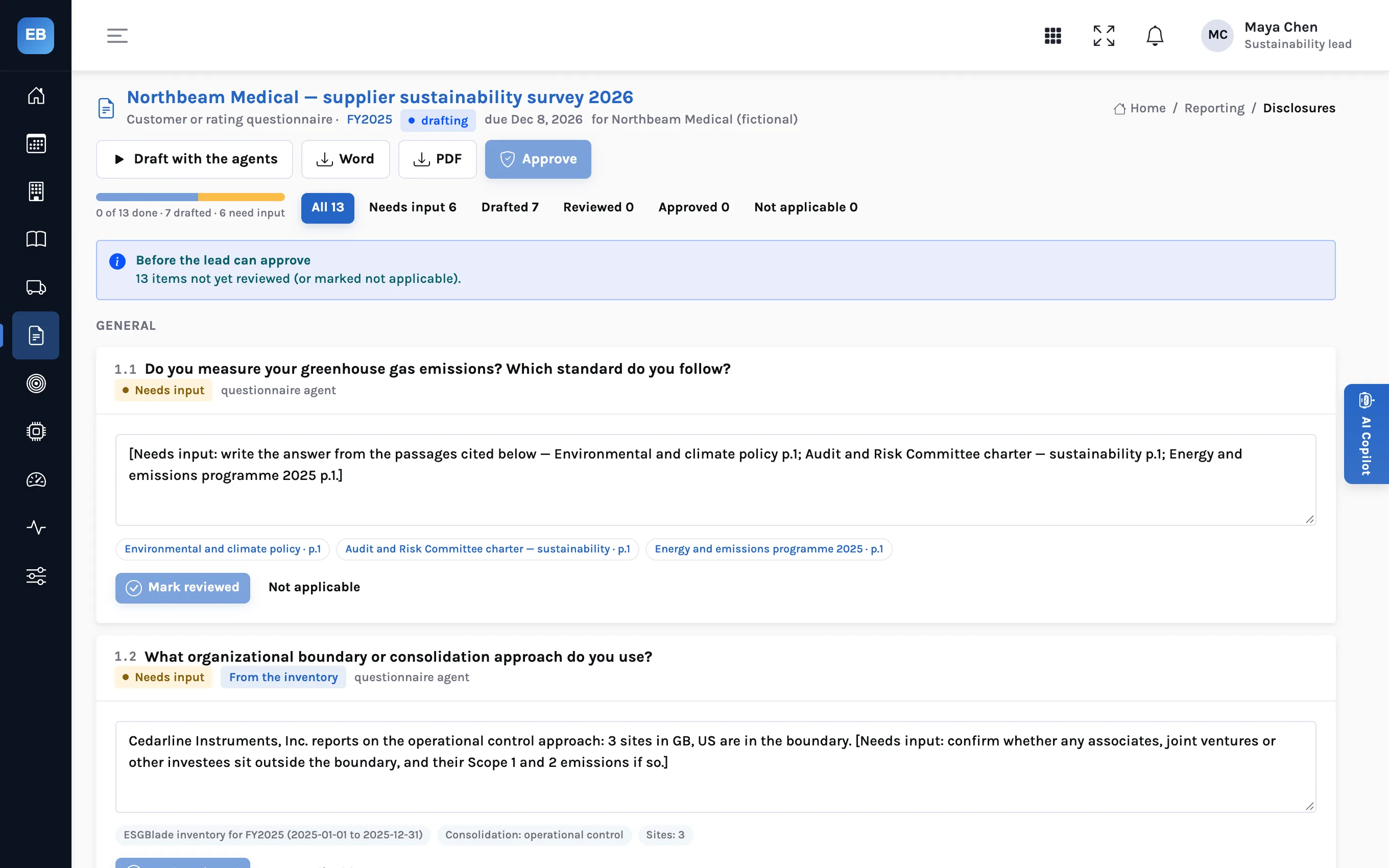
Next, see CSRD and ESRS E1 for a mid-sized company, or how agents prepare and people decide. The disclosures ESGBlade supports are listed on frameworks.
Agree the formula before you score, write down why, and let the threshold do its job.
Try it on your own data
ESGBlade is free. Tell us about your company and we'll set up a workspace for your first reporting period.
Request a demo