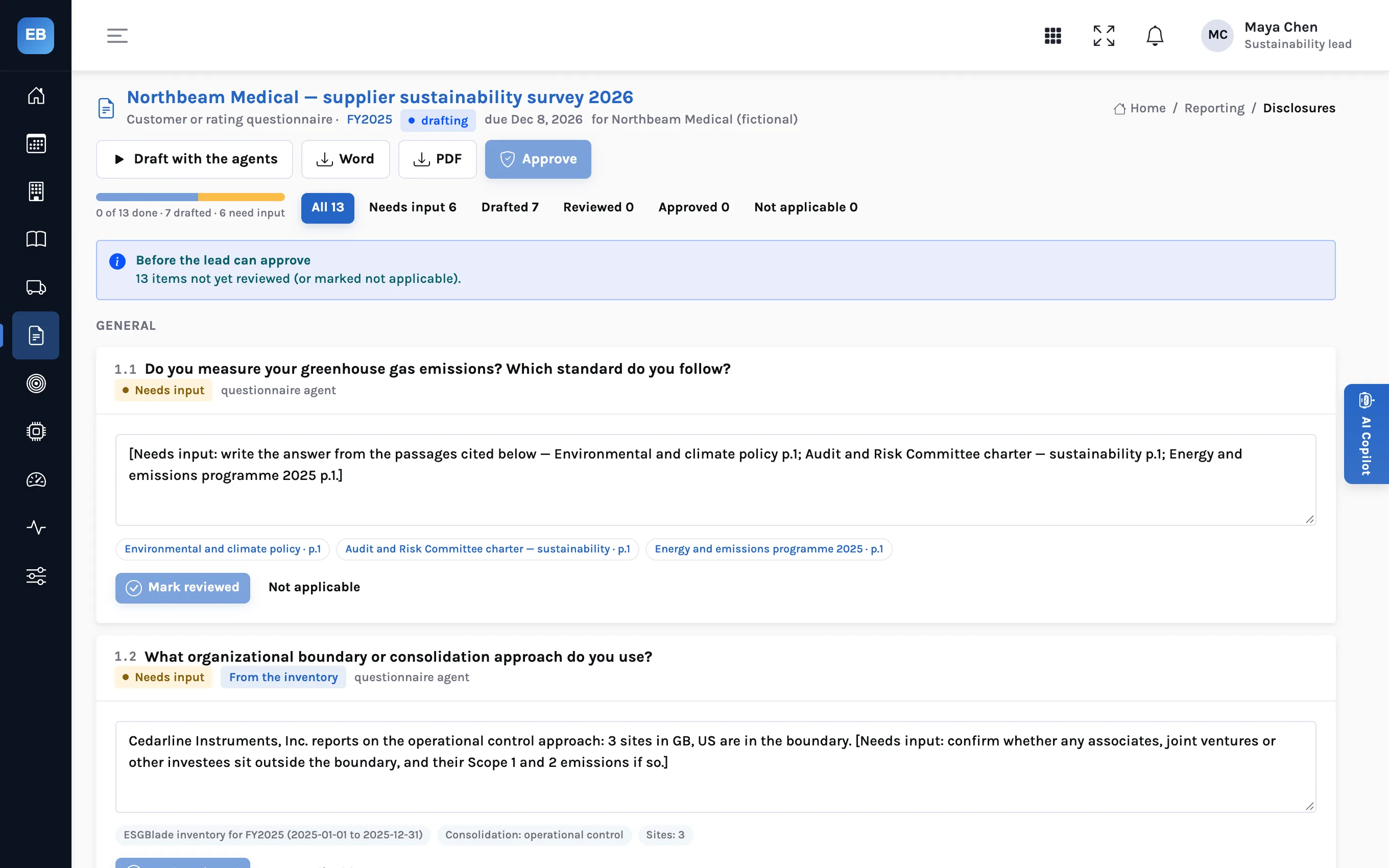
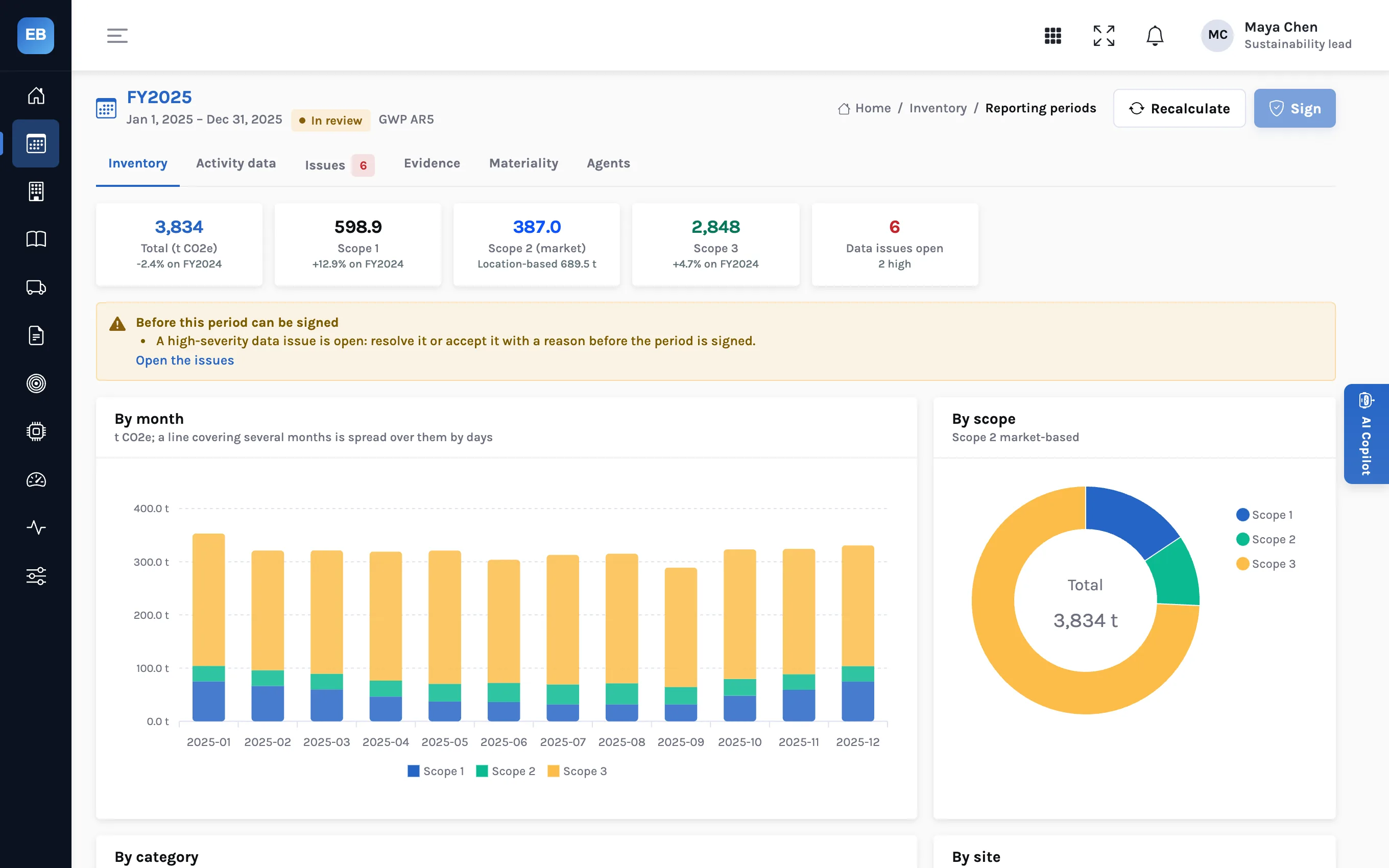
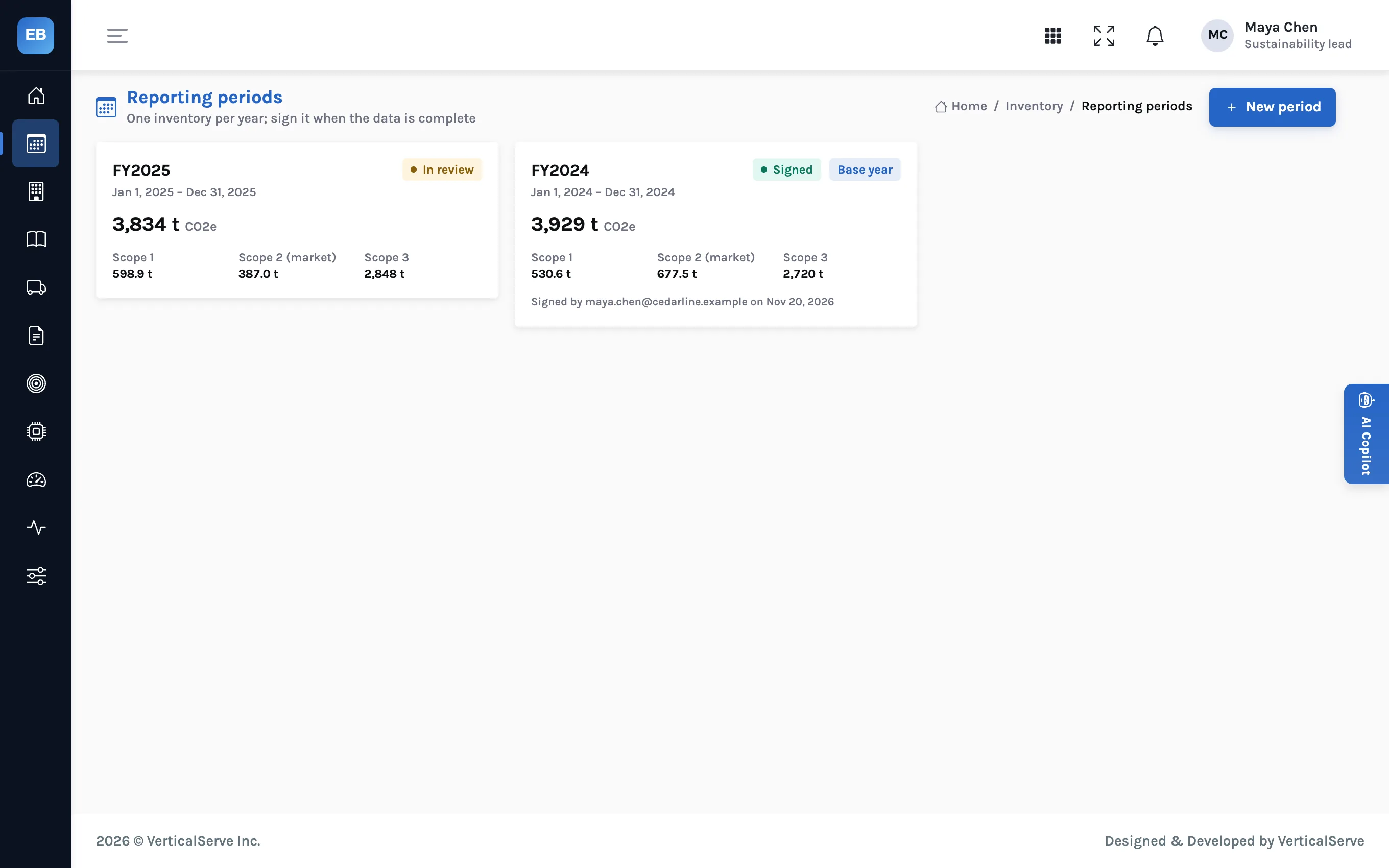
GRI 305: Emissions 2016 is the emissions standard in the Global Reporting Initiative's set. It is voluntary, widely used in sustainability reports, and often the first framework a mid-sized company reports against, because it asks for things a good GHG inventory already holds. It is also precise: it wants Scope 1 broken down by gas, a stated base year, a named consolidation approach and named factor sources.
This post goes through 305-1 to 305-5 and then shows the demo company's FY2024 GRI 305 disclosure, which its sustainability lead has approved.
What each disclosure asks
305-1 Direct (Scope 1) emissions
- Gross Scope 1 in tonnes of CO2 equivalent.
- The gases included: CO2, CH4, N2O, HFCs, PFCs, SF6, NF3, or all of them.
- Biogenic CO2, reported separately from the gross figure. This is CO2 from burning or breaking down biomass, such as wood pellets or biofuels.
- The base year: why it was chosen, its emissions, and any recalculations since.
- The source of the emission factors and the global warming potential (GWP) rates used.
- The consolidation approach: equity share, financial control or operational control.
305-2 Energy indirect (Scope 2) emissions
Gross location-based Scope 2 and, where the company has contractual instruments, gross market-based Scope 2. Base year, factors and consolidation are reported as for 305-1.
305-3 Other indirect (Scope 3) emissions
Gross Scope 3, and which categories and activities are included. GRI doesn't require every category, but it does require you to say which ones you counted.
305-4 Emissions intensity
An intensity ratio and the denominator you chose: revenue, units produced, floor area, employees. State which scopes the ratio covers.
305-5 Reduction of emissions
Reductions achieved as a direct result of reduction initiatives, against a baseline. Lower emissions because the company made less, or sold a site, don't count as reductions under 305-5.
Not covered here
GRI 305 also has 305-6 (ozone-depleting substances) and 305-7 (NOx, SOx and other air emissions). ESGBlade doesn't draft those two.
The twelve items ESGBlade drafts
| Item | What it asks | Source in ESGBlade |
|---|---|---|
| 305-1 a | Gross Scope 1 | From the inventory |
| 305-1 b | Gases included | From the inventory, by gas |
| 305-1 c | Biogenic CO2 | A person states it |
| 305-1 d | Rationale, base year emissions, recalculations | From the base year period |
| 305-1 e | Source of factors and GWPs | From the inventory set-up |
| 305-1 f | Equity share, financial or operational control | From the company profile |
| 305-2 a | Location-based Scope 2 | From the inventory |
| 305-2 b | Market-based Scope 2 | From the inventory |
| 305-3 a | Gross Scope 3 | From the inventory |
| 305-3 d | Scope 3 categories included | From the inventory |
| 305-4 a | Intensity ratio and denominator | From the inventory and revenue |
| 305-5 a | Reductions from initiatives | Drafted from the change; a person checks |
The FY2024 example
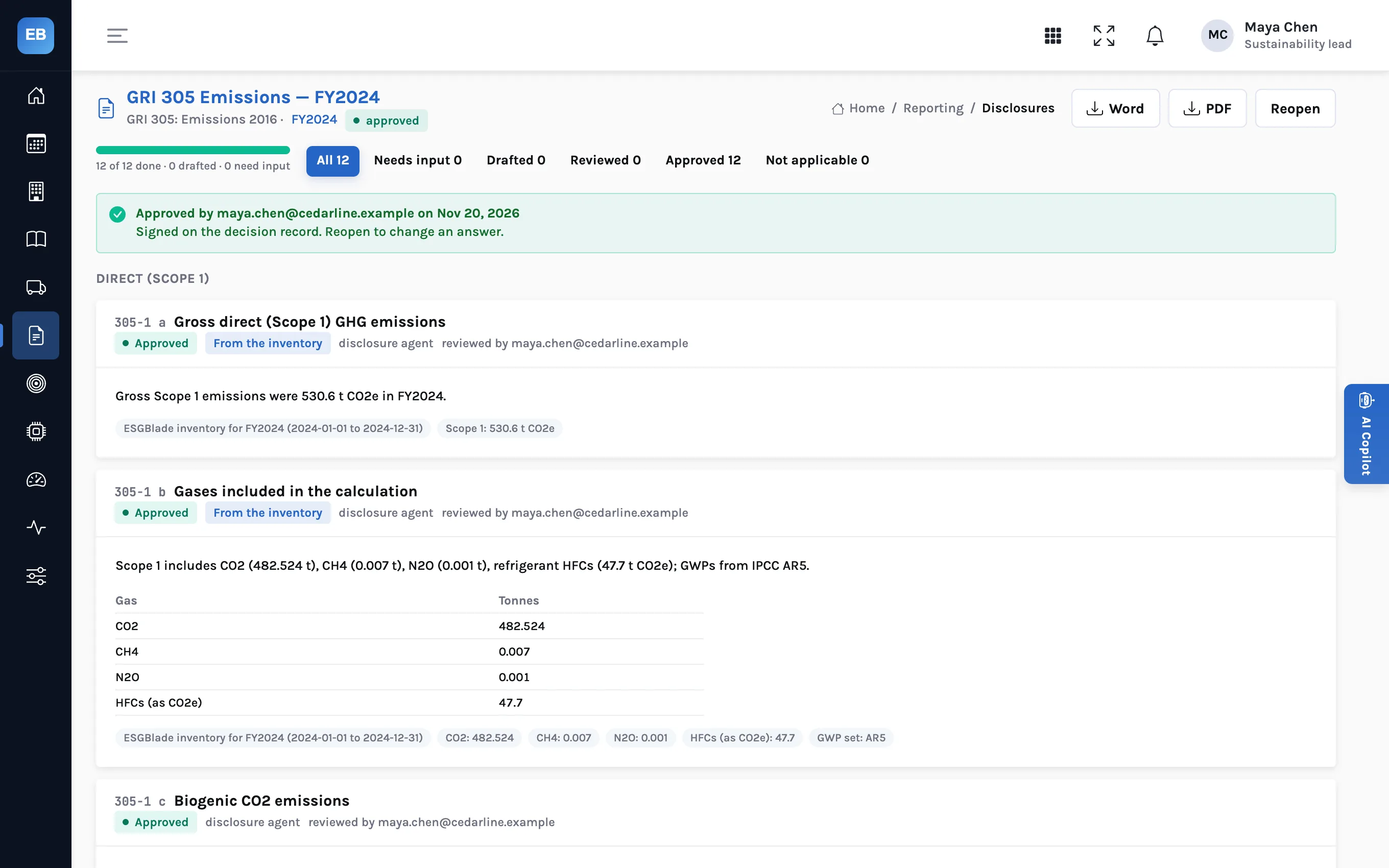
Cedarline Instruments is a fictional instruments maker with three sites: San Jose, Austin and Leeds. FY2024 is its base year and is signed. Its GRI 305 disclosure for FY2024 has all 12 items approved.
Scope 1 by gas
Gross Scope 1 for FY2024 was 530.6 t CO2e. The gases item breaks that down:
| Gas | FY2024 | Where it comes from |
|---|---|---|
| CO2 | 482.524 t | Fuel burned on site and in company vehicles |
| CH4 | 0.007 t | The same combustion, converted with IPCC AR5 GWPs |
| N2O | 0.001 t | The same combustion, converted with IPCC AR5 GWPs |
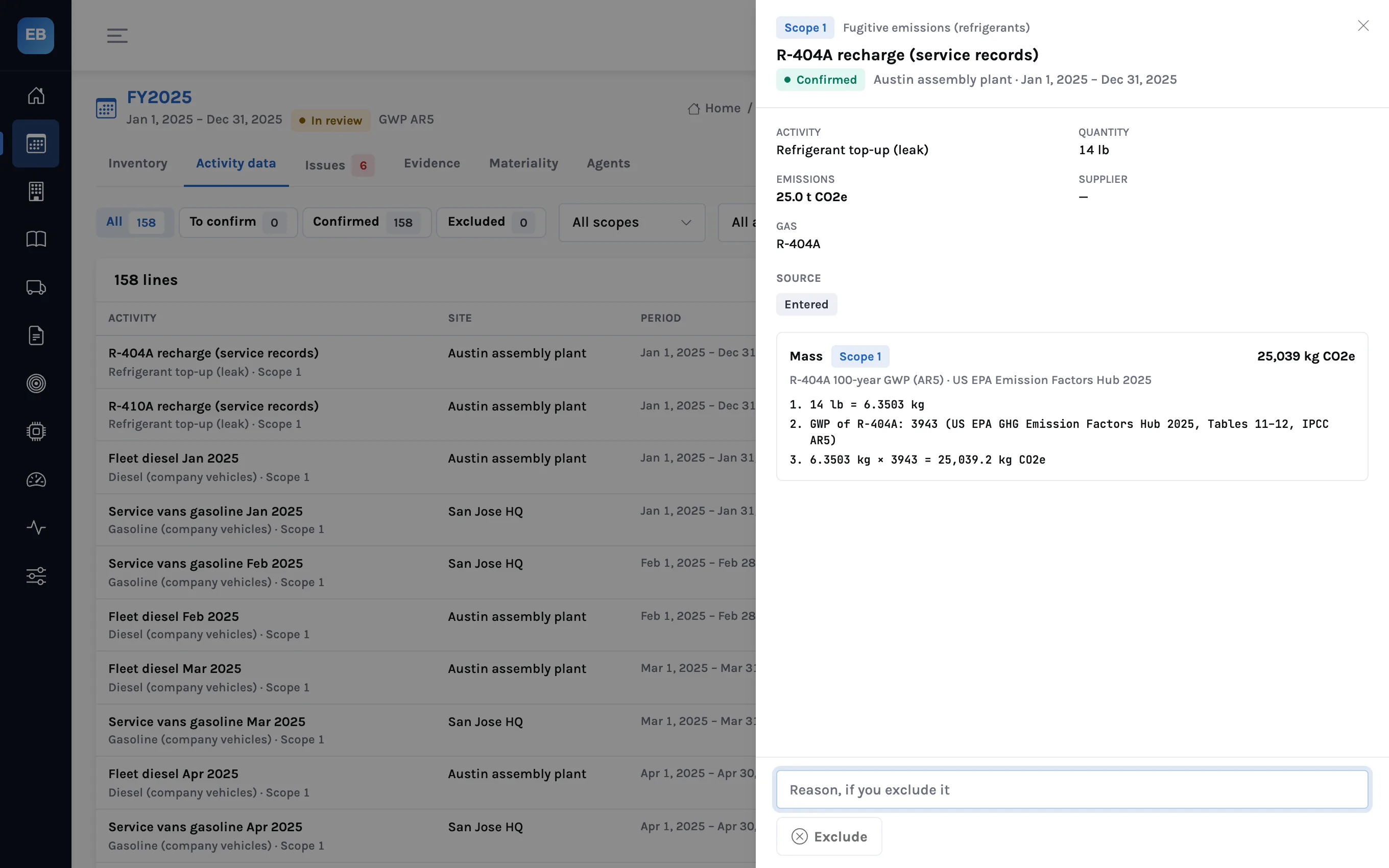
| HFCs | 47.7 t CO2e | Refrigerant top-ups, by mass × GWP |
Methane and nitrous oxide are tiny in tonnes but are reported because GRI asks which gases were included. The HFCs are already CO2 equivalent: a refrigerant top-up is weighed in kilograms and multiplied by the refrigerant's GWP. ESGBlade keeps the gases separate because its factors carry CO2, CH4 and N2O per unit.
Biogenic CO2
Biogenic CO2 is stated by a person. For Cedarline, a person wrote the answer and marked it reviewed. If you do burn wood, biogas or biofuel blends, work the biogenic share out separately and enter it.
Base year, factors and consolidation
- Base year: FY2024, a signed year, with total emissions of 3,929 t CO2e. Write down the policy for recalculating it (for example, after an acquisition) before you need it.
- Factors and GWPs: US EPA GHG Emission Factors Hub 2025, eGRID2023, UK DESNZ conversion factors and USEEIO 1.3, with IPCC AR5 100-year GWPs.
- Consolidation: operational control, covering Cedarline Instruments, Inc. and Cedarline Instruments UK Ltd.
For FY2024 Scope 2 was 677.5 t on both bases, because Cedarline held no contractual instruments that year. Scope 3 was 2,720 t.
Step by step
- Set the consolidation approach, entities and sites in the company profile, and mark the base year period.
- Build and check the inventory for the year. Resolve or accept every data issue, with a reason.
- The sustainability lead signs the period on the decision record.
- Create the GRI 305 disclosure for that period and press Draft with the agents.
- Review the figures. Write the biogenic CO2 answer and check 305-5 against the initiatives that actually reduced emissions.
- Mark each item reviewed or not applicable. The lead presses Approve; the approval goes on the decision record and the disclosure is locked until someone presses Reopen.
- Export to Word or PDF for your sustainability report or GRI content index.
Where people stay in charge
- A person states biogenic CO2. Item 305-1 c is written by a person and marked reviewed.
- A person checks reductions. Item 305-5 is drafted from the change between periods, and a person checks it.
- The lead signs and approves. The lead signs the period and approves the disclosure on the decision record; it is locked until someone presses Reopen.
- Your report, your claim. ESGBlade exports this disclosure; your company builds its GRI report and makes its own claim about reporting in accordance.
For how each figure traces to its source, see every figure traces to a page and a factor; for Scope 2, location-based and market-based Scope 2. Other frameworks are on frameworks.
GRI 305 asks for what a good inventory already knows, broken down by gas, with its sources named.
Try it on your own data
ESGBlade is free. Tell us about your company and we'll set up a workspace for your first reporting period.
Request a demo