A food or beverage plant cooks, chills and packs. That makes its own footprint a mix of gas for boilers and ovens, electricity for refrigeration and lines, and refrigerant that leaks from the cold chain. Behind it sits a much larger footprint in the ingredients and packaging it buys.
This post maps those sources to the GHG Protocol, looks at who is asking processors for data, and shows how ESGBlade turns the plant's records into an inventory.
The sources, by scope
| Source | Scope and category | What you record |
|---|---|---|
| Natural gas or propane for boilers, ovens, fryers, steam | Scope 1, stationary combustion | Bills, read into draft lines |
| Purchased steam or heat | Scope 2 | Steam or heat lines |
| Refrigerant top-ups in chillers, cold stores, blast freezers | Scope 1, fugitive | Mass topped up × GWP, e.g. R-404A, R-410A, HFC-134a |
| Delivery vans and forklifts on diesel or gasoline | Scope 1, mobile combustion | Fuel lines |
| Grid electricity | Scope 2 | Bills; location-based and market-based |
| Ingredients and packaging | Scope 3, category 1 | Purchase ledger spend, USEEIO by NAICS; supplier figures where you have them |
| Inbound freight, including chilled | Scope 3, category 4 | Freight lines by mode, in ton-miles or tonne-km |
| Food waste, packaging waste, wastewater sludge | Scope 3, category 5 | Waste lines by material and treatment |
| Water supply | Scope 3, category 1 | Water supply lines |
Why the refrigerant line matters
R-404A has an AR5 GWP of 3,943, so each kilogram topped up counts as almost 4 t CO2e. A top-up is the mass you replaced, so the service engineer's record is the source document.
Who is asking
Retailers and food service buyers, mostly. Grocers and large brands that have set Scope 3 targets need their suppliers' figures, and most of their footprint sits with suppliers. They ask through supplier portals, annual questionnaires, or as part of a range review: Scope 1 and 2, sometimes Scope 3, whether you have a reduction target, and what you are doing about refrigerants and energy. Food companies selling into the EU may also get CSRD-driven requests from customers who report under it; check the current scope, which has been changing.
How a refrigerant line is calculated
ESGBlade multiplies the mass topped up by the gas's GWP from IPCC AR5 100-year, and keeps the arithmetic. Here is a line from the demo:
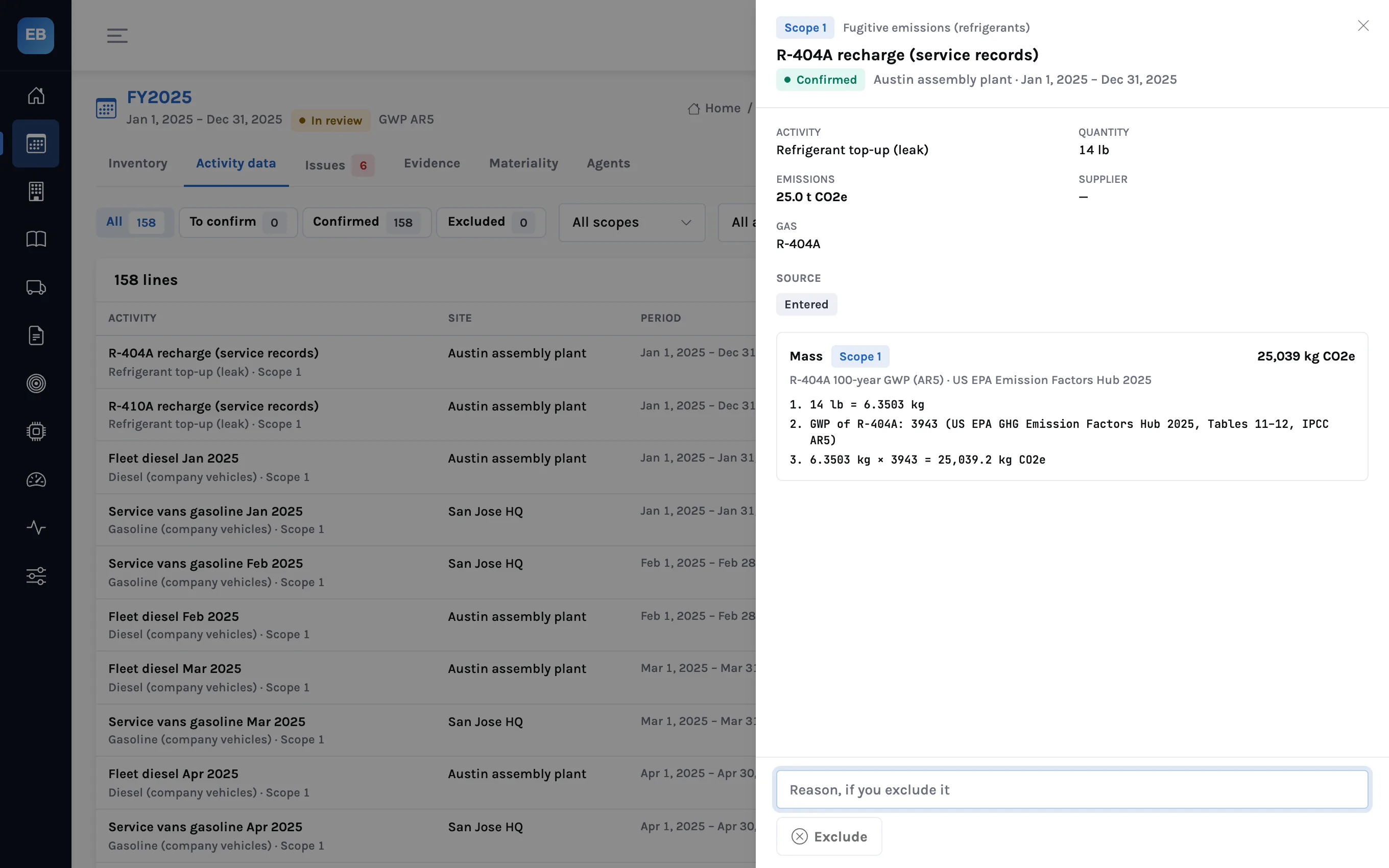
Every figure in the inventory opens like this. See every figure traces to a page and a factor.
How ESGBlade handles it, step by step
- Set up the plants and the cold store as sites, with country, eGRID subregion for US sites, floor area and headcount.
- Upload gas and electricity bills. The extraction agent reads quantity, unit, service period and account into draft lines cited to the page. Scanned PDFs are refused; enter them by hand.
- Enter refrigerant top-ups by gas and mass, as manual lines or with the generic activity template.
- Import the ledger and the waste report. Ingredient and packaging suppliers get a USEEIO factor by industry; waste lines carry material and treatment.
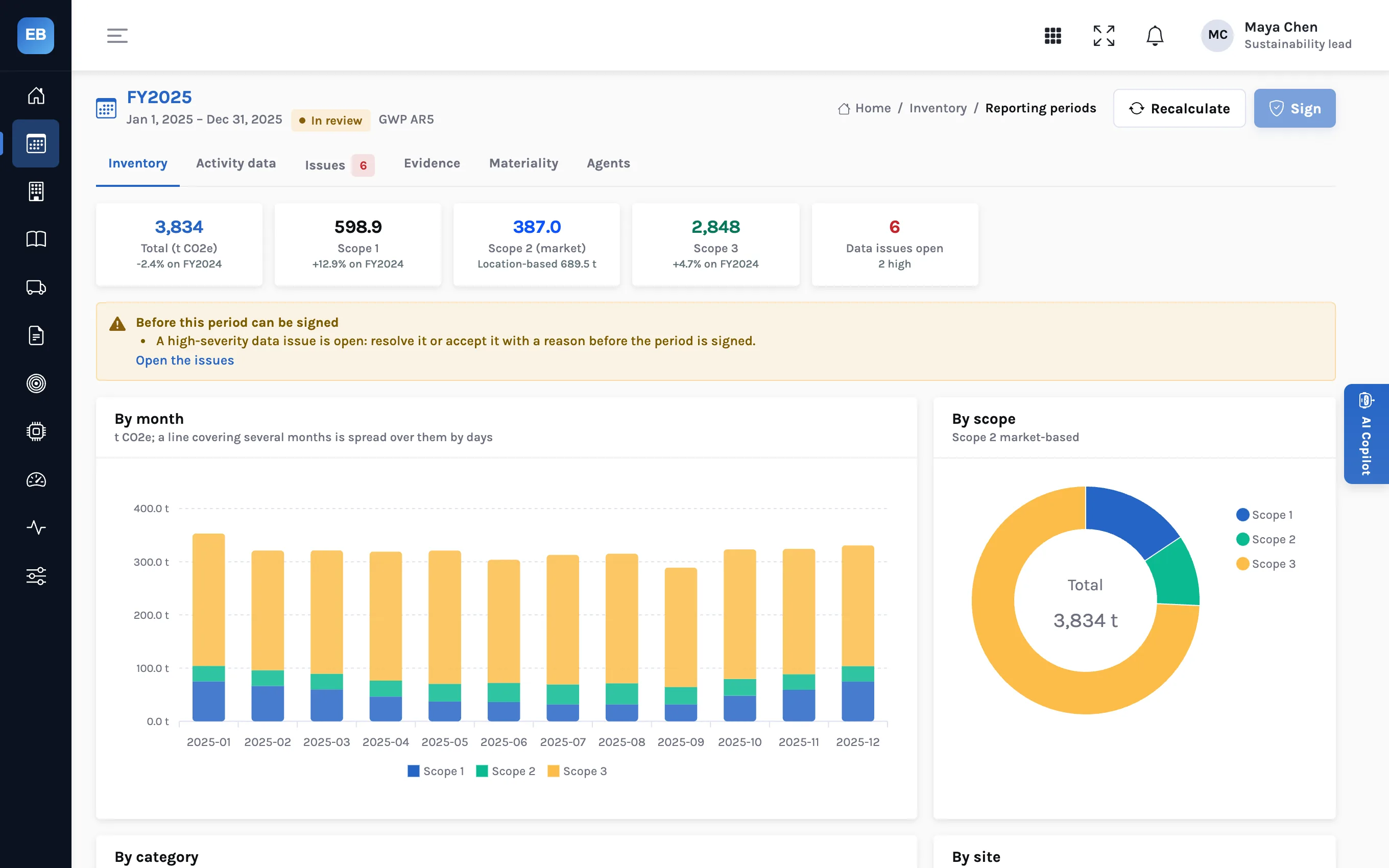
- Run the agents. The data quality agent flags missing months per site and fuel, duplicate bills, and swings of 30% or more, which is how the demo flagged a 30% rise in refrigerant top-ups at one site. The inventory analyst says what drives each scope.
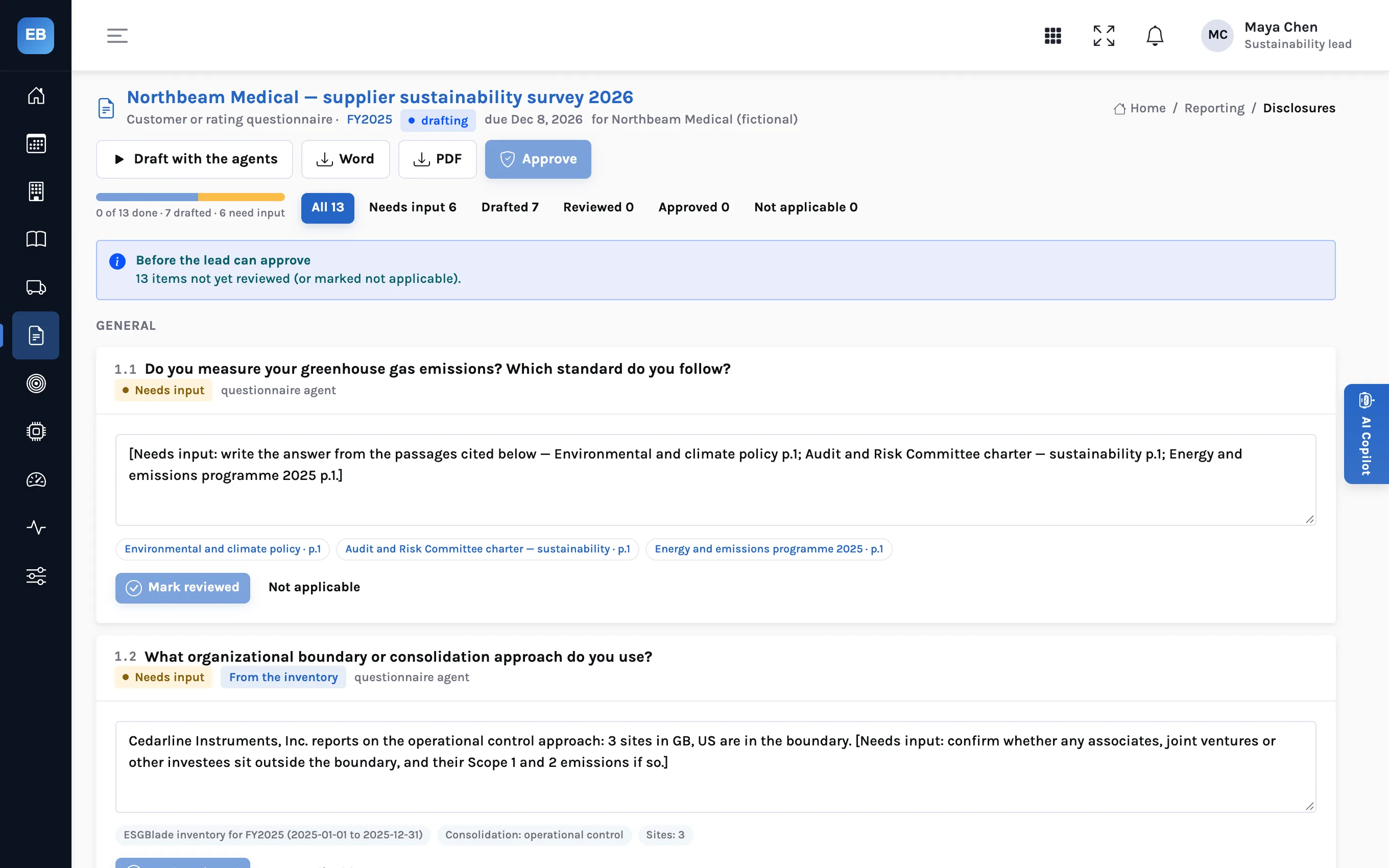
- Sign the period, then answer. Import the retailer's questionnaire; the questionnaire responder drafts from the inventory with citations and marks what needs input.
Ingredients will dominate and they start as spend-based estimates. Then ask your largest suppliers for their own figures: asking suppliers for their own numbers. If the retailer asks about targets, see a reduction target you can track.
Where people stay in charge
- The lead signs before you answer. The period is signed on the decision record before the retailer's questionnaire is answered.
- Ingredient figures by choice. Supplier requests are held until a person sends them, and a supplier's figure is used only when a person chooses to use it.
- Needs input goes to a person. The questionnaire responder marks what the inventory can't answer for a person to fill.
What to do first
- Get a year of refrigerant service records with gas type and mass added
- Collect gas and electricity bills for every plant and cold store
- Export the purchase ledger with supplier names
- Ask your waste contractor for tonnes by material and treatment
In food processing, the refrigerant log is a source document. Treat it like a bill.
Try it on your own data
ESGBlade is free. Tell us about your company and we'll set up a workspace for your first reporting period.
Request a demo